Table of Contents
- What Is a Home Loan Eligibility Calculator and Why Is It ...
- Key Factors That Determine Your Home Loan Eligibility
- How to Use a Home Loan Eligibility Calculator – Step‑by‑Step
- Home Loan Eligibility by Salary – Detailed Table
- How Much Home Loan Can I Get on ₹50,000 Salary?
- How Much Home Loan Can I Get on ₹75,000 Salary?
- Home Loan Eligibility for Salaried Employees
- Home Loan Eligibility for Self‑Employed Individuals
- How EMIs Affect Your Home Loan Eligibility
- SBI Home Loan Eligibility Calculator
- Bank-wise Comparison: SBI, HDFC, ICICI, Axis Bank
- Step‑by‑Step Calculation Examples
- Expert Tips to Increase Your Home Loan Eligibility
- Internal Linking Suggestions
- FAQs about of home loan eligibilty calculator
- Conclusion
Home Loan Eligibility Calculator – Know Your Borrowing Limit Before You Apply
Buying a home is a big financial decision. Most people in India depend on a home loan to make this dream come true. But before you visit any bankermart.com or fill out an application form, you must know one important thing – how much loan can you actually get? This is where a Home Loan Eligibility Calculator becomes your best friend.
A home loan eligibility calculator is a simple online tool. It helps you estimate the maximum loan amount a bank may offer you based on your income, expenses, age, and other factors. Banks in India follow RBI guidelines to decide your loan eligibility. Instead of guessing, you can use this calculator to get a clear number.
In this detailed guide, we will explain everything about home loan eligibility.
We will cover salary‑wise calculations, rules for salaried and self‑employed individuals, how existing EMIs affect your loan, and even bank‑specific eligibility for SBI, HDFC, ICICI, and Axis Bank. We will also share expert tips to increase your eligibility. By the end, you will know exactly how to plan your home loan journey.
What Is a Home Loan Eligibility Calculator and Why Is It Important?
A Home Loan Eligibility Calculator is an online tool provided by banks, NBFCs, and financial websites. You enter your monthly income, existing loan EMIs, desired loan tenure, and your age. The calculator then shows an approximate loan amount you may qualify for.
Why Should You Use It Before Applying for a Home Loan?
- Saves time – You avoid applying to banks where you do not meet the criteria.
- Improves your planning – You know your budget and can search for properties accordingly.
- Helps improve your profile – If the eligibility is low, you can reduce existing debts or choose a longer tenure.
- No impact on credit score – Using a calculator does not involve a credit inquiry, unlike a loan application.
RBI has made it mandatory for banks to publish their loan eligibility criteria. But a calculator gives you a personalised estimate.
Key Factors That Determine Your Home Loan Eligibility
Banks in India evaluate several factors before approving a home loan. Understanding these will help you use the eligibility calculator correctly.
Monthly Income
Your monthly take‑home salary or business profit is the starting point. Higher income means higher loan amount. Banks typically allow 40% to 55% of your monthly income to go towards EMI payments.
Existing EMIs and Other Obligations
If you are already paying EMIs for a car loan, personal loan, or credit card dues, your home loan eligibility reduces. Banks use the FOIR (Fixed Obligation to Income Ratio). In most cases, total monthly EMIs (including the proposed home loan EMI) should not exceed 50% to 55% of your monthly income.
Age of the Applicant
Younger applicants get longer tenures. A person aged 25 can get a loan up to 30 years, while someone aged 50 may get only 10–15 years. Longer tenure means lower EMI and higher eligibility.
Employment Type – Salaried vs Self‑Employed
- Salaried employees need at least 2‑3 years of work experience with regular salary credits. Banks ask for salary slips, Form 16, and bank statements.
- Self‑employed individuals need 3‑5 years of ITR (Income Tax Returns) with business continuity. They may get slightly lower eligibility because income may fluctuate.
Credit Score (CIBIL Score)
A credit score above 750 is ideal. A low score (below 650) can lead to rejection or lower loan amount. Some banks may offer loans at higher interest rates for scores between 650‑700.
Loan Tenure
Longer tenure reduces the EMI amount, which can increase your eligibility. However, you pay more total interest. Shorter tenure increases EMI, so eligibility drops.
Property Value and Down Payment
Banks finance up to 75‑90% of the property value (Loan to Value ratio). The rest you pay as down payment. So your eligibility also depends on the cost of the property you wish to buy.
How to Use a Home Loan Eligibility Calculator – Step‑by‑Step
You can find a home loan eligibility calculator on any bank’s website or on aggregator portals. Here is how to use it.
- Enter your monthly income – Include salary, bonuses, rental income, or business profit.
- Enter your current EMIs – Car loan, personal loan, education loan, etc.
- Select your age – Most calculators ask for age or remaining working years.
- Choose loan tenure – Usually 5 to 30 years.
- Select interest rate (optional) – Some calculators ask for an approximate rate, say 8.5% per annum.
- Click “Calculate” – The tool shows the maximum loan amount you may get.
Example calculation – A salaried person aged 30, earning ₹60,000 per month, with no existing EMIs, and a tenure of 20 years at 8.5% interest, may get eligibility around ₹55‑60 lakh.
Home Loan Eligibility by Salary – Detailed Table
To make it easy, we have prepared a salary‑wise home loan eligibility table. This is a general estimate assuming:
- No existing EMIs
- Age between 25‑40 years
- Loan tenure of 20 years
- Interest rate ~8.5% per annum
- FOIR of 50%
Monthly Salary (₹)Approx Eligible Loan Amount (₹)25,00018 – 22 lakh30,00022 – 27 lakh40,00030 – 36 lakh50,00038 – 45 lakh60,00046 – 55 lakh75,00058 – 70 lakh1,00,00080 – 95 lakh
Note: The actual amount may vary based on your credit score, age, bank policies, and existing loans.
How Much Home Loan Can I Get on ₹50,000 Salary?
If your monthly salary is ₹50,000, banks will consider about 50% of your income for EMI calculation. That is ₹25,000 available for home loan EMI (assuming no other EMIs).
Using a standard home loan EMI calculator:
- Loan amount ₹40 lakh at 8.5% for 20 years → EMI approx ₹34,700 (slightly above 25,000, so lower amount).
- Loan amount ₹35 lakh → EMI approx ₹30,400 (still high).
- Loan amount ₹30 lakh → EMI approx ₹26,000 (close to limit).
- Loan amount ₹28 lakh → EMI approx ₹24,300 (safe).
Thus, a person earning ₹50,000 per month can typically get a home loan between ₹28 lakh to ₹35 lakh depending on tenure and interest rate. If you choose 25 years tenure, you may get up to ₹38 lakh.
Example with existing EMI: If you already pay ₹8,000 EMI for a car loan, your available capacity becomes ₹17,000 (25,000 – 8,000). Then your eligible loan drops to around ₹18‑20 lakh.
How Much Home Loan Can I Get on ₹75,000 Salary?
Monthly salary ₹75,000 → 50% FOIR = ₹37,500 available for EMI.
- For 20 years at 8.5%, loan amount ₹50 lakh → EMI approx ₹43,400 (too high).
- Loan amount ₹45 lakh → EMI approx ₹39,000 (still slightly above limit).
- Loan amount ₹42 lakh → EMI approx ₹36,500 (within limit).
- Loan amount ₹40 lakh → EMI approx ₹34,700 (comfortable).
So a person earning ₹75,000 can expect a home loan between ₹42 lakh and ₹50 lakh, depending on tenure and other factors. With 25‑year tenure, the amount can go up to ₹55 lakh.
Home Loan Eligibility for Salaried Employees
Salaried employees are the largest group of home loan borrowers in India. Banks have a clear set of rules for them.
Documentation Needed
- Last 3‑6 months’ salary slips
- Form 16 for last 2 years
- Bank statements for last 6 months (showing salary credits)
- Identity and address proof (Aadhaar, PAN, Voter ID, passport)
- Employment contract or appointment letter
Key Eligibility Criteria
- Minimum age – 21 years (at loan start), maximum age at loan maturity – 60 years for most banks, some allow 65.
- Work experience – Minimum 1‑2 years in current job, with total work experience of 2‑3 years.
- Company profile – Working for a reputed MNC, public sector, or established private company helps get lower interest rates.
- Salary account – Having a salary account with the same bank can improve eligibility and processing speed.
How to Increase Eligibility for Salaried Applicants
- Reduce existing debts – pay off car loan or credit card dues.
- Add a co‑applicant (working spouse or parent) to combine income.
- Choose a longer repayment tenure to lower EMI.
- Improve credit score by paying all dues on time.
Home Loan Eligibility for Self‑Employed Individuals
Self‑employed professionals (doctors, lawyers, consultants) and business owners have a different eligibility assessment.
Documentation Needed
- Income Tax Returns (ITR) for last 3‑5 years
- Profit & Loss statement and Balance Sheet (audited if turnover exceeds limits)
- Bank statements for last 12 months
- GST registration and returns (if applicable)
- Proof of business existence (Shop & Establishment, trade license)
Key Eligibility Criteria
- Business continuity – Minimum 3‑5 years in current business.
- Profit after tax – Banks take average profit of last 2‑3 years. They may add back depreciation and other non‑cash expenses.
- Age – Maximum age at loan maturity usually 65 years.
- Tax compliance – Higher declared income in ITR improves eligibility.
Loan Amount Estimate for Self‑Employed
A self‑employed person with annual profit of ₹6 lakh may get around ₹30‑35 lakh loan, whereas a salaried person with same ₹50,000 monthly income may get similar amount. However, banks often offer 10‑15% lower loan amount to self‑employed due to perceived income volatility.
Tips for Self‑Employed to Improve Eligibility
- Keep personal and business accounts separate.
- Show all income in ITR – do not under‑report.
- Maintain a good credit score (above 750).
- Provide clear audited financials.
How EMIs Affect Your Home Loan Eligibility
EMI is the equated monthly instalment you pay to the bank. When you already have EMIs, your ability to pay another EMI reduces. This is the most important factor after income.
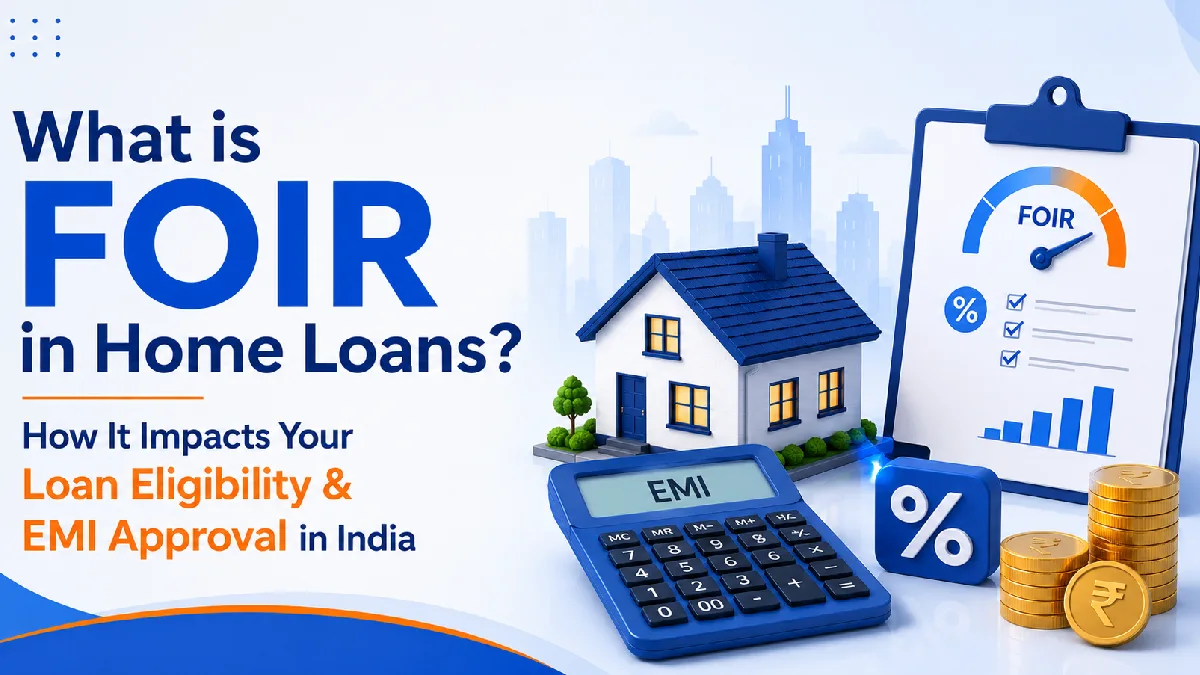
FOIR Explained
FOIR (Fixed Obligation to Income Ratio) is the percentage of your income that goes towards EMIs of all ongoing loans plus the proposed home loan EMI. RBI does not set a fixed FOIR, but most banks keep it between 45% and 55%.
Example: Monthly income ₹80,000. Existing EMIs ₹15,000. FOIR limit 50%. Maximum EMI allowed = ₹40,000. Therefore, home loan EMI cannot exceed ₹25,000 (40,000 – 15,000). This reduces your eligible loan amount.
How to Calculate Your Maximum EMI
- Find your monthly take‑home income.
- Multiply by 0.50 (or bank’s FOIR). This is total EMI capacity.
- Subtract existing EMIs.
- The remaining is the EMI you can afford for a home loan.
Practical Example
Mr. Sharma earns ₹1,00,000 per month. He pays ₹20,000 EMI for a car and personal loan. Bank’s FOIR is 55%. Total permissible EMI = ₹55,000. Remaining for home loan = ₹35,000. At 8.5% for 20 years, this EMI gives a loan amount of approx ₹40 lakh. Without existing loans, he could have got around ₹70 lakh.
SBI Home Loan Eligibility Calculator
State Bank of India (SBI) is the largest home loan lender in India. SBI provides an online home loan eligibility calculator on its website and YONO app.
Key Eligibility Criteria for SBI
- Salaried – Minimum age 21 years, maximum 70 years (retirement age considered). Minimum income of ₹25,000 per month in metro cities, ₹15,000 in non‑metros.
- Self‑employed – Minimum age 21 years, maximum 70 years. Minimum ITR of ₹2 lakh per annum for past 2 years.
- Credit score – SBI prefers CIBIL score of 750 or above. Lower score may still get loan but with higher interest or stricter terms.
- Tenure – Up to 30 years, subject to age.
SBI’s Special Schemes
- SBI MaxGain – Overdraft home loan where you can deposit surplus funds to reduce interest.
- SBI Privilege Home Loan – For government employees, offers 5 bps lower interest.
- SBI Flexi Pay – For young professionals with step‑up EMI option.
How to Use SBI’s Calculator
Visit SBI’s official website → Home Loans → Eligibility Calculator → Enter income, other EMIs, tenure → Get approximate loan amount.
Bank-wise Comparison: SBI, HDFC, ICICI, Axis Bank
Different banks have slightly different eligibility rules. Below is a comparison table.
BankMinimum Income (Salaried)Maximum TenureFOIRCredit Score PreferredKey FeatureSBI₹25,000 (metro)30 years50‑55%750+Lowest interest, large networkHDFC₹20,000 (tier-2 cities)30 years50‑60%700+Fast processing, doorstep serviceICICI₹25,00030 years50%750+Fully digital application, pre‑approved offersAxis₹25,00030 years50‑55%750+Balance transfer and top‑up options
Note: Self‑employed income requirements are usually higher – minimum ITR of ₹2‑3 lakh per annum.
Step‑by‑Step Calculation Examples
Let us take two real‑life examples to understand the eligibility calculation manually.
Example 1 – Salaried Employee
- Monthly income: ₹70,000
- Existing EMIs: ₹10,000
- Age: 32
- Desired tenure: 25 years
- Interest rate assumed: 8.5%
Step 1: Total permissible EMI (50% of income) = ₹35,000
Step 2: EMI available for home loan = ₹35,000 – ₹10,000 = ₹25,000
Step 3: Use EMI formula or online calculator: For ₹25,000 EMI, 8.5% interest, 25 years → Loan amount approx ₹32 lakh.
Thus, he can apply for a loan of up to ₹32 lakh.
Example 2 – Self‑Employed Professional
- Annual profit as per ITR: ₹8,00,000
- Monthly average profit: ₹66,667
- Existing loans: None
- Age: 35
- Tenure: 20 years
Step 1: Banks take 50‑60% of monthly profit as repayment capacity. Assume 50% = ₹33,333.
Step 2: EMI available = ₹33,333.
Step 3: For 20 years, 8.5% interest, ₹33,333 EMI → Loan amount approx ₹38‑40 lakh.
Expert Tips to Increase Your Home Loan Eligibility
You can improve your eligibility without increasing your income. Here are practical tips.
- Add a co‑applicant – Spouse or parent with stable income. Their income and credit score will be combined.
- Clear small loans – Pay off credit card dues and close personal/car loans before applying.
- Choose longer tenure – Reduces EMI, increases eligibility. You can always prepay later.
- Improve credit score – Pay all bills on time, maintain low credit utilisation.
- Opt for a lower property value – If you are buying an affordable home, the loan requirement is lower, making approval easier.
- Shift salary account – Some banks offer higher eligibility if you maintain a salary account with them.
- Show all income sources – Include bonuses, overtime, rental income, or dividends in your application.
Internal Linking Suggestions
- For detailed terms of SBI home loan, read our guide: SBI Home Loan.
- If you want to compare with private lenders, see HDFC Home Loan and ICICI Home Loan.
- Also consider linking to pages like “Home Loan Interest Rates Today” or “Documents Required for Home Loan”.
FAQs about of home loan eligibilty calculator
- What is the minimum salary required for a home loan in India?
- Most banks require a minimum monthly salary of ₹15,000 in small towns and ₹25,000 in metro cities. For self‑employed, minimum annual ITR of ₹2 lakh is common.
- How is home loan eligibility calculated?
- It depends on your monthly income, existing EMIs, age, loan tenure, and credit score. Banks generally allow 50‑55% of your income to go towards EMI.
- Can I get a home loan without a CIBIL score?
- Yes, some banks offer loans to first‑time borrowers with no credit history, but they may ask for a co‑applicant or higher down payment. Interest rates could be higher.
- How much home loan can I get on ₹30,000 salary?
- Approximately ₹22‑27 lakh for 20‑year tenure, assuming no other EMIs and good credit score.
- Does adding a co‑applicant increase the loan amount?
- Yes. The combined income of all co‑applicants is considered, and their existing EMIs are also added. This can significantly increase eligibility.
- Is there any difference in eligibility for government employees?
- Many banks offer special schemes for government employees, sometimes with lower interest rates and higher FOIR (up to 60%).
- Can I get a home loan if I have a low CIBIL score (650‑700)?
- Some banks may approve at a higher interest rate. Work on improving your score before applying to get better terms.
- How does the RBI repo rate affect my eligibility?
- When RBI increases repo rate, home loan interest rates rise. Higher interest means higher EMI, which reduces the eligible loan amount for the same income.
- What is the maximum home loan amount for a self‑employed person?
- There is no fixed maximum. It depends on your annual profit. Banks may offer up to 4‑6 times your annual profit, subject to FOIR.
- Should I use an online eligibility calculator before visiting a bank?
- Absolutely. It gives you a realistic idea and helps you negotiate better. It also saves you from unnecessary credit inquiries.
- What is the best home loan tenure for maximum eligibility?
- Longer tenure (25‑30 years) reduces EMI, thereby increasing eligibility. You can always prepay later to close the loan early.
- Do banks consider spouse’s income automatically?
- Only if you add your spouse as a co‑applicant. Then both incomes are clubbed, and both are equally responsible for repayment.
- How much down payment do I need to arrange?
- Minimum 10‑20% of the property value. The rest is financed by the bank. Larger down payment reduces loan amount and improves eligibility.
- Can freelance income be considered?
- Yes, if you have ITR proof for at least 2‑3 years. Banks treat freelancers as self‑employed.
- What is the maximum age limit for a home loan?
- Most banks allow repayment up to age 60 for salaried and 65‑70 for self‑employed. Some banks go up to 75 years with a younger co‑applicant.
Conclusion
A Home Loan Eligibility Calculator is the first step towards a stress‑free home buying journey. Instead of applying randomly and facing rejection, take five minutes to calculate how much you can actually afford. Understand the factors that influence your eligibility – income, existing loans, age, employment type, and credit score. Use the salary‑wise table and examples to estimate your loan amount. If you are a salaried employee or self‑employed, follow the tips to improve your eligibility before applying.
Compare banks like SBI, HDFC, ICICI, and Axis to find the best interest rate and terms. Always check the RBI guidelines regarding FOIR and LTV ratios. Remember, a higher eligibility does not mean you should take the maximum loan. Borrow only what you need and what you can comfortably repay.
Plan your finances, keep your credit score healthy, and then apply for a home loan with confidence. Start with an eligibility calculator today.