Table of Contents
- What is CIBIL Score?
- What is PAN Card's Role in Checking CIBIL Score?
- Can You Check CIBIL Score Using Only PAN?
- Step-by-Step Process to Check CIBIL Score by PAN Card
- Documents and Information Required
- How is CIBIL Score Calculated?
- CIBIL Score Range Explained
- Factors Affecting Your Credit Score
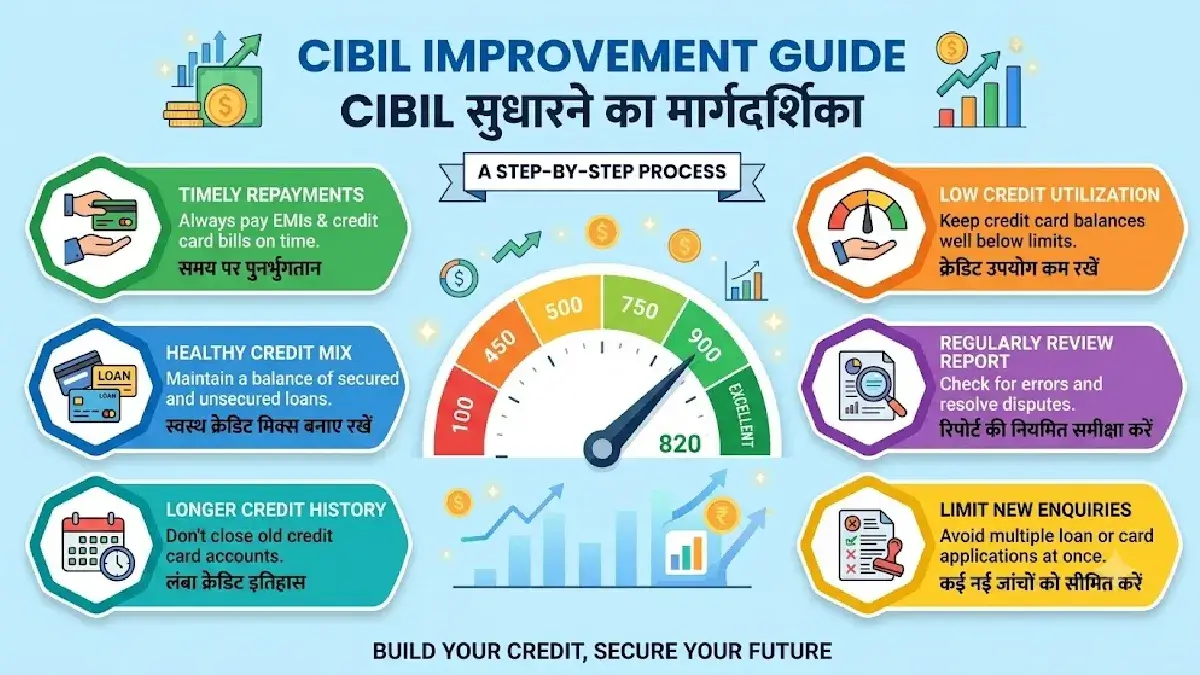
- How to Improve Your Credit Score
- Credit Score Improvement Timeline
- Common Mistakes to Avoid When Checking Your Score
- Benefits of Checking Your Credit Score Regularly
- Credit Score Required for Different Loans & Cards
- Difference Between CIBIL, Experian, Equifax & CRIF
- Credit Report Explained
- Errors in Credit Report & How to Raise a Dispute
- How Long Does Credit Score Improvement Take?
- Do's and Don'ts for a Good Credit Score
- Myth vs Fact: Credit Score Myths Busted
- Frequently Asked Questions (FAQs)
- Conclusion
EMI Calculator
Home Loan EMI Calculator
Live| 📊 Rate | 8.50% |
| ⏱️ Tenure | 20 years |
| 💰 Total Interest | ₹ 0 |
| 💵 Total Payment | ₹ 0 |
Amortization Schedule Monthly
| # | Date | EMI (₹) | Principal (₹) | Interest (₹) | Balance (₹) |
|---|---|---|---|---|---|
| Calculating... | |||||
Your CIBIL score is one of the most important numbers in your financial life. Whether you are applying for a home loan, a personal loan, a car loan, or a credit card, lenders first check your CIBIL score to decide if you are creditworthy. A good score can get you quick approvals and lower interest rates, while a poor score can lead to rejections or higher borrowing costs.
But here is the question that millions of Indians ask every day: How can I check my CIBIL score quickly and easily?
The answer for many is: Check CIBIL Score by PAN Card. Your Permanent Account Number (PAN) is linked to your financial identity. Many platforms allow you to check your credit score online using your PAN card. But is that enough? What else do you need? How accurate is it? And most importantly, what should you do after checking your score?
This comprehensive guide answers all these questions. We will explain what a CIBIL score is, how your PAN card connects to it, the step-by-step process to check your score, what the different score ranges mean, and how you can improve your score before applying for a loan. We will also show you how BankerMart—an independent loan comparison platform—can help you understand your credit profile better and find the right loan offers based on your score.
What is CIBIL Score?
CIBIL stands for Credit Information Bureau (India) Limited. It is India's first and most widely used credit information company. CIBIL is now known as TransUnion CIBIL after its merger with TransUnion, a global credit reporting agency.
Your CIBIL score is a three-digit number ranging from 300 to 900. It represents your creditworthiness based on your past borrowing and repayment behaviour. The closer your score is to 900, the better your credit profile.
Why is CIBIL Score Important?
| Aspect | Impact |
|---|---|
| Loan Approval | Higher score increases approval chances |
| Interest Rate | Better score = lower interest rate |
| Credit Limit | Good score = higher credit card limits |
| Processing Time | Strong score = faster processing |
| Negotiating Power | Good score helps you negotiate better terms |
Who Calculates Your CIBIL Score?
TransUnion CIBIL collects data from banks, financial institutions, and credit card companies. They gather information about your:
Loan accounts (home loans, personal loans, auto loans, etc.)
Credit card accounts
Repayment history (on-time or delayed payments)
Credit enquiries (how many times you have applied for credit)
Based on this data, CIBIL calculates your credit score using a proprietary algorithm.
What is PAN Card's Role in Checking CIBIL Score?
Your Permanent Account Number (PAN) is a unique 10-character alphanumeric identifier issued by the Income Tax Department of India. It is mandatory for financial transactions above certain limits, making it a key link to your financial identity.
How PAN is Connected to Your Credit Profile
| Connection | Explanation |
|---|---|
| Unique Identifier | PAN is unique to each individual, making it easy to track credit history |
| Loan Applications | Banks require PAN for all loan applications above ₹50,000 |
| Tax Compliance | PAN links your income and tax details to your financial profile |
| Credit Reporting | Lenders report your credit activity using your PAN as the primary identifier |
Why PAN is Used for Credit Score Checks
When you apply to check your credit score, the platform uses your PAN to:
Verify your identity – PAN is a government-issued ID, making it reliable.
Pull your credit report – Your PAN is linked to all your loan and credit card accounts.
Prevent fraud – PAN helps ensure that the credit report belongs to the right person.
Important Note: BankerMart is not a credit bureau. We display your credit score only through authorized partner integrations. The score is fetched directly from TransUnion CIBIL or other credit bureaus through secure APIs. We do not store or misuse your personal information.
Can You Check CIBIL Score Using Only PAN?
The short answer is NO. You cannot check your exact CIBIL score using only your PAN card.
Why PAN Alone is Not Enough
While your PAN is a critical piece of information, credit bureaus and authorized platforms require additional details to:
| Requirement | Purpose |
|---|---|
| PAN Number | To identify your financial history |
| Full Name | To match with PAN records |
| Date of Birth | To confirm identity and avoid mismatch |
| Mobile Number | To send OTP for verification |
| Email Address | To send your credit report |
| OTP Verification | To ensure it is really you checking your score |
What Happens When You Check Your Score
You enter your PAN and personal details.
You verify your identity through an OTP sent to your registered mobile number.
The platform securely fetches your credit report from the credit bureau.
You see your score and report.
Warning: Be very careful about sharing your PAN and personal details. Only use trusted and authorized platforms to check your credit score. Fake websites may misuse your data for fraud.
Myth vs Fact
| Myth | Fact |
|---|---|
| I can check my CIBIL score using just my PAN card. | You need PAN + personal details + OTP verification. |
| Checking my score lowers my CIBIL score. | A self-check is a \"soft enquiry\" and does not affect your score. |
| All platforms show the same score. | Different credit bureaus may show slightly different scores. |
Step-by-Step Process to Check CIBIL Score by PAN Card
Here is a simple step-by-step guide to check your CIBIL score online using your PAN card.
Step 1: Choose a Trusted Platform
Select a platform that is authorized to access your credit report. BankerMart offers this service through secure partner integrations. You can also use the official TransUnion CIBIL website or other RBI-approved credit bureaus.
Step 2: Enter Your PAN Card Details
You will need to provide your 10-digit PAN number (e.g., ABCDE1234F). Ensure you enter it correctly—an incorrect PAN may lead to an error or no report found.
Step 3: Fill in Personal Information
Most platforms ask for basic details such as:
Full name (as on PAN)
Date of birth
Registered mobile number
Email address
Step 4: Verify Your Identity with OTP
You will receive a One-Time Password (OTP) on your registered mobile number. Enter this OTP to confirm your identity. This is a mandatory step to ensure security and prevent unauthorized access.
Step 5: View Your CIBIL Score and Report
Once your identity is verified, your CIBIL score and credit report will be displayed. You can usually:
View your score instantly
Download your full credit report as a PDF
Analyse your report to understand the factors affecting your score
Expert Tip: Do not check your score too frequently through different platforms. While soft enquiries do not affect your score, some platforms may run a \"hard enquiry\" if you are applying for a loan, which can temporarily lower your score.
Documents and Information Required
Documents Required
| Document | Purpose |
|---|---|
| PAN Card | Primary identifier for checking credit history |
| Aadhaar Card | Often used for identity verification |
| Voter ID / Passport | Optional, but may be needed for additional verification |
Information Required
| Information | Purpose |
|---|---|
| Full Name | As mentioned on PAN |
| Date of Birth | For identity verification |
| Registered Mobile Number | To receive OTP |
| Email Address | To receive credit report |
| OTP | To confirm identity |
Who is Eligible to Check Their CIBIL Score?
| Eligibility | Condition |
|---|---|
| Indian Citizens | Must have a valid PAN card |
| NRIs / OCIs | May be eligible if they have a PAN and Indian financial history |
| Minor (Under 18) | Not eligible to check score independently |
Note: PAN verification may require OTP and identity verification depending on the provider. BankerMart follows strict security protocols to protect your data.
How is CIBIL Score Calculated?
Your CIBIL score is calculated based on five key factors. Each factor has a different weightage in the overall calculation.
Credit Score Calculation Factors
| Factor | Weightage | Description |
|---|---|---|
| Payment History | ~35% | Whether you pay your EMIs and credit card bills on time |
| Credit Utilization | ~30% | How much of your available credit limit you are using |
| Credit Mix | ~15% | The types of credit you have (secured vs unsecured) |
| Credit Age | ~10% | How long you have been using credit |
| Credit Enquiries | ~10% | How many times you have applied for new credit recently |
How Each Factor Affects Your Score
Payment History (~35%)
This is the most important factor. Every late payment or default can significantly lower your score. Paying on time, every time, is the single best way to maintain a good score.
Credit Utilization (~30%)
This is the percentage of your total credit limit that you are using. For example, if your total credit card limit is ₹1,00,000 and you have a balance of ₹50,000, your utilization is 50%. Keeping this below 30% is ideal.
Credit Mix (~15%)
Having a mix of secured loans (home loan, car loan) and unsecured credit (personal loan, credit cards) shows lenders that you can handle different types of credit responsibly.
Credit Age (~10%)
The longer your credit history, the better. It gives lenders more data to assess your repayment behaviour. Closing your oldest credit card can reduce your credit age and potentially lower your score.
Credit Enquiries (~10%)
Every time you apply for a loan or credit card, the lender runs a \"hard enquiry\" on your credit report. Multiple enquiries in a short period can hurt your score because it signals that you are credit-hungry.
CIBIL Score Range Explained
Your CIBIL score falls into one of five ranges. Here is what each range means for your creditworthiness.
CIBIL Score Range Table
| Score Range | Category | What It Means |
|---|---|---|
| 750 – 900 | Excellent | Low risk for lenders. Quick approvals and best interest rates. |
| 700 – 749 | Very Good | Low risk. Most loan applications are approved. |
| 650 – 699 | Good | Moderate risk. Approval is likely but may come with higher interest rates. |
| 550 – 649 | Fair | High risk. Approval is not guaranteed. May require collateral or a co-applicant. |
| 300 – 549 | Poor | Very high risk. Loan applications are often rejected. |
Loan Approval Chances by Score
| Score Range | Approval Chances | Interest Rate Impact |
|---|---|---|
| 750 – 900 | Very High | Best rates (lowest) |
| 700 – 749 | High | Competitive rates |
| 650 – 699 | Moderate | Slightly higher rates |
| 550 – 649 | Low | High rates (if approved) |
| 300 – 549 | Very Low | May not be approved |
Impact of CIBIL Score on Home Loan Interest Rate
| CIBIL Score | Approximate Interest Rate (Home Loan) |
|---|---|
| 750+ | 7.25% – 7.50% |
| 700 – 749 | 7.75% – 8.00% |
| 650 – 699 | 8.25% – 8.75% |
| 550 – 649 | 9.00% – 9.50% |
| Below 550 | 10%+ or rejection |
These are indicative rates. Actual rates depend on the lender, loan amount, and other factors.
Factors Affecting Your Credit Score
Understanding what affects your credit score is the first step to improving it.
1. Payment History
On-time payments → Increase your score.
Late payments → Decrease your score.
Defaults → Significant drop in score.
Expert Tip: Set up auto-pay or reminders to ensure you never miss a payment. Even one 30-day late payment can hurt your score for months.
2. Credit Utilization Ratio
High utilization (above 30%) → Your score goes down.
Low utilization (below 30%) → Your score improves.
Zero utilization → May not help because lenders want to see responsible credit use.
Expert Tip: If you have a high credit card balance, try to pay it down before the billing cycle ends. This lowers your reported utilization.
3. Credit Mix
A good mix of secured and unsecured loans helps your score.
Too many unsecured loans (personal loans, credit cards) may hurt your score.
4. Credit Age
Older credit accounts → Good for your score.
Closing old accounts → Can lower your score.
Expert Tip: Keep your oldest credit card active, even if you do not use it much. It helps your credit age.
5. Loan Enquiries
Hard enquiries (loan applications) → Temporary dip in score.
Soft enquiries (self-checks) → No impact.
Warning: Avoid applying for multiple loans or credit cards within a short period. Each hard enquiry can lower your score by a few points.
How to Improve Your Credit Score
Improving your CIBIL score takes time and consistent effort. Here are 10 actionable tips to boost your score.
1. Pay All Bills on Time
Your payment history is the most important factor. Make sure you pay your EMIs and credit card bills on or before the due date.
2. Reduce Credit Utilization
Try to keep your credit card utilization below 30%. If you have a ₹1,00,000 limit, try not to use more than ₹30,000.
3. Avoid Multiple Loan Applications
Do not apply for multiple loans or credit cards in a short period. Each application leads to a hard enquiry, which temporarily lowers your score.
4. Check Your Credit Report Regularly
Review your credit report at least once a year. Look for errors and get them corrected promptly.
5. Maintain a Healthy Credit Mix
Having a mix of secured (home loan, car loan) and unsecured (personal loan, credit card) credit can help your score.
6. Keep Old Credit Cards Open
The age of your credit history matters. Do not close your oldest credit cards unless absolutely necessary.
7. Set Up Payment Reminders
Use reminders, auto-debit, or mobile alerts to ensure you never miss a payment.
8. Reduce Existing Debt
Pay off your outstanding loans and credit card balances as quickly as possible. A lower debt burden improves your credit utilization.
9. Become an Authorized User
If your family member has a good credit card history, ask them to add you as an authorized user. Their good history can help your credit profile.
10. Wait it Out
Negative marks (like late payments) stay on your report for 7 years. If you have a poor score, follow the above steps consistently and your score will gradually improve.
Credit Score Improvement Timeline
| Timeframe | What to Expect |
|---|---|
| 1 – 3 Months | Small improvements if you correct errors or reduce utilization |
| 3 – 6 Months | Noticeable improvement with consistent on-time payments |
| 6 – 12 Months | Significant improvement, especially if you pay off debt |
| 12 – 24 Months | Major improvement. Your score can move up by 50-100 points |
| 24+ Months | Sustained improvement. You can reach an excellent score range |
Expert Tip: There is no \"quick fix\" for a bad credit score. Be patient and consistent. The best way to improve your score is to demonstrate responsible credit behavior over time.
Common Mistakes to Avoid When Checking Your Score
| Mistake | Why It's a Problem |
|---|---|
| Checking score on unverified sites | Your data could be misused. |
| Entering wrong PAN details | You may not get your report. |
| Checking score too frequently | Some platforms may run hard enquiries. |
| Ignoring errors in the report | Errors can lower your score unfairly. |
| Not comparing scores across bureaus | Different bureaus may have different data. |
Benefits of Checking Your Credit Score Regularly
| Benefit | Explanation |
|---|---|
| Know Your Standing | You know where you stand before applying for a loan. |
| Detect Errors | Identify and fix mistakes in your credit report. |
| Prevent Fraud | Detect unauthorized credit applications. |
| Improve Score | Know what to work on to improve your score. |
| Negotiate Better Rates | A good score gives you negotiating power. |
| Plan Better | Plan your loan applications based on your score. |
Credit Score Required for Different Loans & Cards
Home Loan
| Score | Likelihood |
|---|---|
| 750+ | High chance, best rates |
| 650-749 | Moderate, may get approval with slightly higher rates |
| Below 650 | Low chance, may need co-applicant or collateral |
Personal Loan
| Score | Likelihood |
|---|---|
| 750+ | High chance, competitive rates |
| 700-749 | Good chance |
| Below 700 | Low chance, very high interest if approved |
Car Loan
| Score | Likelihood |
|---|---|
| 750+ | High chance, best rates |
| 700-749 | Good chance |
| Below 700 | May be approved with higher down payment |
Education Loan (Abroad)
| Score | Likelihood |
|---|---|
| 750+ | High chance, better terms |
| 700-749 | Good chance |
| Below 700 | May require a co-signer or collateral |
Business Loan
| Score | Likelihood |
|---|---|
| 750+ | High chance, competitive rates |
| 700-749 | Good chance |
| Below 700 | May be difficult without strong business financials |
Credit Cards (Premium / Rewards)
| Score | Likelihood |
|---|---|
| 750+ | High chance for premium cards |
| 700-749 | Good chance for standard cards |
| Below 700 | Only basic/fd-backed cards may be approved |
Difference Between CIBIL, Experian, Equifax & CRIF
In India, there are four RBI-registered credit bureaus. Here is a quick comparison.
Credit Bureau Comparison Table
| Bureau | Full Name | Key Feature |
|---|---|---|
| CIBIL | Credit Information Bureau (India) Ltd | Most widely used, trusted by most banks |
| Experian | Experian Credit Information Company | Global presence, used by many NBFCs |
| Equifax | Equifax Credit Information Services | Strong in consumer credit data |
| CRIF High Mark | CRIF High Mark Credit Information Services | Widely used for MSME and consumer loans |
Key Differences
| Aspect | CIBIL | Experian | Equifax | CRIF |
|---|---|---|---|---|
| Popularity | Most popular in India | Popular with NBFCs | Popular with some banks | Popular with microfinance |
| Score Range | 300 – 900 | 300 – 900 | 300 – 900 | 300 – 900 |
| Data Sources | Banks, credit card companies | Banks, NBFCs, utilities | Banks, NBFCs | NBFCs, microfinance |
| Report Delivery | Online, PDF | Online, PDF | Online, PDF | Online, PDF |
Important: Your score may vary slightly across different bureaus because each bureau may have slightly different data. Always check your score from multiple bureaus before applying for a loan.
Credit Report Explained
Your credit report is a detailed document that contains all your credit-related information.
What is a Credit Report?
A credit report is a summary of your credit history. It includes:
| Section | Details |
|---|---|
| Personal Information | Name, PAN, date of birth, address |
| Credit Accounts | All loans, credit cards, and their status |
| Payment History | On-time payments, late payments, defaults |
| Credit Enquiries | List of lenders who have checked your report |
| Public Records | Bankruptcies, legal judgments (if any) |
How to Read Your Credit Report
Check Personal Information: Ensure your name, PAN, and date of birth are correct.
Review Credit Accounts: Verify that all listed accounts belong to you.
Check Payment History: Ensure there are no incorrect late payment marks.
Review Credit Enquiries: Check if there are any unauthorized enquiries.
Look for Errors: Identify and note any mistakes.
Errors in Credit Report & How to Raise a Dispute
Common Errors in Credit Report
| Error | Impact |
|---|---|
| Wrong personal details | Can lead to mix-up with another person's credit history |
| Incorrect loan amount | May show higher debt than actual |
| Late payment wrongly marked | Unfairly lowers your score |
| Closed accounts showing as open | Inflates your total credit |
| Duplicate accounts | Shows more credit than actual |
| Fraudulent accounts | Indicates identity theft |
How to Raise a Dispute
| Step | Action |
|---|---|
| 1 | Identify the error in your report. |
| 2 | Visit the credit bureau's official website (CIBIL, Experian, Equifax, or CRIF). |
| 3 | Go to the \"Dispute\" or \"Raise a Dispute\" section. |
| 4 | Fill in the dispute form with details of the error. |
| 5 | Upload supporting documents (bank statements, loan statements, etc.). |
| 6 | Submit the dispute. The bureau will investigate and update your report. |
| 7 | The process usually takes 30–45 days. |
Expert Tip: Keep a copy of your dispute acknowledgment number for tracking. If the error is not resolved, escalate to the ombudsman or RBI.
How Long Does Credit Score Improvement Take?
| Improvement Type | Typical Timeline |
|---|---|
| Correcting an error | 30–60 days (after dispute resolution) |
| Paying off a default | 1–3 months to see a small improvement |
| Reducing utilization | 1–2 months (after next billing cycle) |
| Building credit history | 6–12 months of consistent payments |
| Significant score jump | 12–24 months with responsible behavior |
Do's and Don'ts for a Good Credit Score
Do's
| Do | Why |
|---|---|
| Pay all bills on time | Maintains positive payment history |
| Keep utilization below 30% | Shows responsible credit use |
| Check your score regularly | Detects errors and fraud early |
| Maintain a healthy credit mix | Shows you can handle different types of credit |
| Keep old credit accounts open | Increases credit age |
| Raise disputes for errors | Corrects your report |
Don'ts
| Don't | Why |
|---|---|
| Apply for multiple loans at once | Hard enquiries hurt your score |
| Max out credit cards | High utilization lowers your score |
| Close old credit accounts | Reduces credit age and limit |
| Ignore your credit report | Errors can go uncorrected |
| Co-sign for someone with poor credit | Their bad behavior affects you |
| Use unreliable platforms to check score | Your data may be compromised |
Myth vs Fact: Credit Score Myths Busted
| Myth | Fact |
|---|---|
| Checking my score lowers it. | Self-check is a \"soft enquiry\" and does not affect your score. |
| I need a high income for a good score. | Your score is about credit behavior, not income. |
| Closing a credit card improves my score. | Closing old cards can reduce your credit age and lower your score. |
| A zero balance is best for credit cards. | Using some credit (and paying it off) shows responsible behavior. |
| Only loans affect my score. | Credit card usage also affects your score. |
| All credit bureaus show the same score. | Each bureau may have slightly different data. |
Frequently Asked Questions (FAQs)
1. Can I check my CIBIL score using only my PAN card?
No. You cannot check your exact CIBIL score using just your PAN card. You also need to provide basic personal details like your name, date of birth, and mobile number for OTP verification.
2. Is it safe to check my CIBIL score online?
Yes, as long as you use a trusted and authorized platform like BankerMart (through secure partner integrations) or the official TransUnion CIBIL website.
3. Does checking my CIBIL score lower it?
No. When you check your own score, it is considered a \"soft enquiry\" and does not affect your score. Only \"hard enquiries\" from lenders can temporarily lower your score.
4. What is a good CIBIL score for a home loan?
A score of 750 and above is considered good for a home loan. It increases your chances of approval and helps you get the best interest rates.
5. What is a good CIBIL score for a personal loan?
A score of 750 and above is recommended for a personal loan. Some lenders may approve loans with scores above 700, but the interest rate may be higher.
6. How can I check my CIBIL score for free?
Many platforms, including BankerMart through its partners, offer a free CIBIL score check once a year or periodically. You can also check once a year for free on the official CIBIL website.
7. Is a PAN card mandatory to check CIBIL score?
Yes, a PAN card is mandatory for most platforms. It is the primary identifier used by credit bureaus in India.
8. Can NRIs check their CIBIL score using a PAN card?
Yes, NRIs and OCIs who have a PAN card and financial history in India can check their CIBIL score.
9. How long does it take to get a CIBIL score after applying?
If you apply online, your score is usually displayed within 1-2 minutes after OTP verification and identity validation.
10. Does a low CIBIL score mean I won't get a loan?
Not necessarily. Some lenders may approve loans with a low score but at a higher interest rate or with additional collateral. However, a low score significantly reduces your chances.
11. Can I check my CIBIL score without an OTP?
No. OTP verification is mandatory for security and to ensure that it is the credit report owner checking the score.
12. What is the minimum CIBIL score for a credit card?
Most standard credit cards require a score of 700 or above. Premium cards typically require 750+. You can get a basic card or a secured card with a lower score.
13. Can I get a home loan with a 650 CIBIL score?
It is possible but challenging. You may get approval with a higher interest rate, a lower loan amount, or the need for a co-applicant or collateral.
14. How often should I check my CIBIL score?
It is advisable to check your score at least once a year. If you are planning to apply for a loan, check it 3-6 months in advance to allow time to improve your score.
15. Does checking my CIBIL score on BankerMart affect my score?
No. BankerMart displays scores through authorized partner integrations using \"soft enquiries,\" which do not affect your credit score.
16. What is the difference between CIBIL score and credit report?
Your CIBIL score is a three-digit number summarizing your creditworthiness. Your credit report is a detailed document that contains all your credit history, accounts, and enquiries.
17. Can I check my spouse's CIBIL score using my PAN?
No. You can only check your own score using your own PAN. However, you and your spouse can check your scores individually.
18. What is a \"hard enquiry\" in credit terms?
A hard enquiry occurs when a lender checks your credit report in response to a loan or credit card application. Multiple hard enquiries in a short period can lower your score.
19. How long do late payments stay on my credit report?
Late payments and defaults can stay on your credit report for up to 7 years from the date of default.
20. Can I check my CIBIL score from my mobile phone?
Yes. Most platforms, including BankerMart, have mobile-friendly websites or apps that allow you to check your score on your phone.
21. What is the role of BankerMart in credit score checking?
BankerMart is not a credit bureau. We display your score through authorized partner integrations. We help you understand your score and connect you with the best loan offers based on your profile.
22. Will applying for multiple loans in a month hurt my score?
Yes. Each application results in a hard enquiry, which can temporarily reduce your score. Try to space out your applications.
23. Can I get a CIBIL score if I have never taken a loan?
If you have never taken a loan or used a credit card, you may not have a CIBIL score. This is known as being \"New to Credit.\" You may need to build a credit history by taking a small loan or using a secured credit card.
24. How is the CIBIL score calculated for self-employed individuals?
The calculation is similar to salaried individuals—based on payment history, credit utilization, credit mix, credit age, and enquiries. However, income stability and business history also play a role in loan approval.
25. Can I check my CIBIL score for free multiple times?
Many platforms offer a free check once a year or as a one-time offer. To check more frequently, you may need to subscribe to a paid plan.
26. What should I do if my CIBIL score has errors?
Raise a dispute with the credit bureau immediately. Provide supporting documents and follow up until the error is corrected.
27. Does the CIBIL score expire?
Your score is dynamic and changes based on your credit behavior. It does not \"expire\" but is updated as lenders report new data. Your score can change every month.
28. Can I get a personal loan with a 700+ score?
Yes. A score of 700+ is generally considered good for a personal loan. However, the final approval depends on your income, existing debt, and the lender's policies.
29. Is the CIBIL score the only factor for loan approval?
No. Lenders also consider your income, job stability, existing debts, LTV ratio, and property documents (for home loans). However, a good score is the most important factor.
30. Can I check my CIBIL score by PAN card without a mobile number?
No. Mobile number is mandatory for OTP verification. If your mobile number is not registered with the bank, you will need to update it first.
31. How long does it take to improve a CIBIL score from 600 to 750?
It can take 12 to 24 months of consistent, responsible credit behavior to improve from 600 to 750. There is no quick fix.
32. What happens if I enter the wrong PAN number?
You will not be able to retrieve your credit report. Double-check your PAN before submitting.
33. Can a company check my CIBIL score without my consent?
No. Under RBI guidelines, a lender or credit bureau can only check your score with your explicit consent, usually through a signed application form.
34. What is a \"New to Credit\" CIBIL score?
If you have no credit history, you may not have a score. Some bureaus assign a \"NTC\" (No Trade Credit) status. You will need to build a credit history.
35. Can I check my child's CIBIL score?
No. Minors (under 18) do not have a credit history or score unless they have a joint account with a parent.
36. Is it true that closing a loan early improves my score?
Closing a loan early does not necessarily improve your score. It may reduce your credit age and mix. However, it reduces your debt burden, which can help your credit utilization.
37. Can I get a home loan with a 700 CIBIL score?
Yes, a score of 700 is acceptable for most lenders. You may get approval, but the interest rate may be slightly higher than someone with a 750+ score.
38. Can BankerMart directly improve my CIBIL score?
No. BankerMart does not directly improve scores. We provide tools, guidance, and comparisons to help you understand and improve your score through responsible financial behavior.
39. Will checking my credit report on BankerMart show up on my report?
No. The check is a soft enquiry and does not appear on your report for lenders to see.
40. Is it safe to share my PAN with BankerMart?
Yes. BankerMart uses secure, encrypted connections and works with authorized partner integrations. We do not store your personal information without consent.
Conclusion
Checking your CIBIL score by PAN card is a simple, secure, and essential step in managing your financial health. Your CIBIL score is more than just a number—it is the key to unlocking affordable credit, lower interest rates, and faster loan approvals. Whether you are applying for a home loan, a personal loan, or a credit card, your score will be the first thing lenders look at.