Table of Contents
- LIC Home Loan Interest Rate 2026
- LIC HFL Interest Rate by CIBIL Score
- What Determines LIC HFL Home Loan Interest Rates?
- LIC HFL Home Loan EMI Calculator 2026
- LIC HFL Home Loan EMI for ₹20 Lakh, ₹30 Lakh and ₹50 Lakh
- LIC HFL Home Loan Eligibility Criteria 2026
- Documents Required for an LIC HFL Home Loan
- LIC HFL Home Loan Processing Fees and Other Charges
- LIC HFL vs SBI vs HDFC Home Loan Interest Rate 2026
- Is LIC HFL a Good Option for Homebuyers in 2026?
- How to Apply for an LIC HFL Home Loan
- Frequently Asked Questions
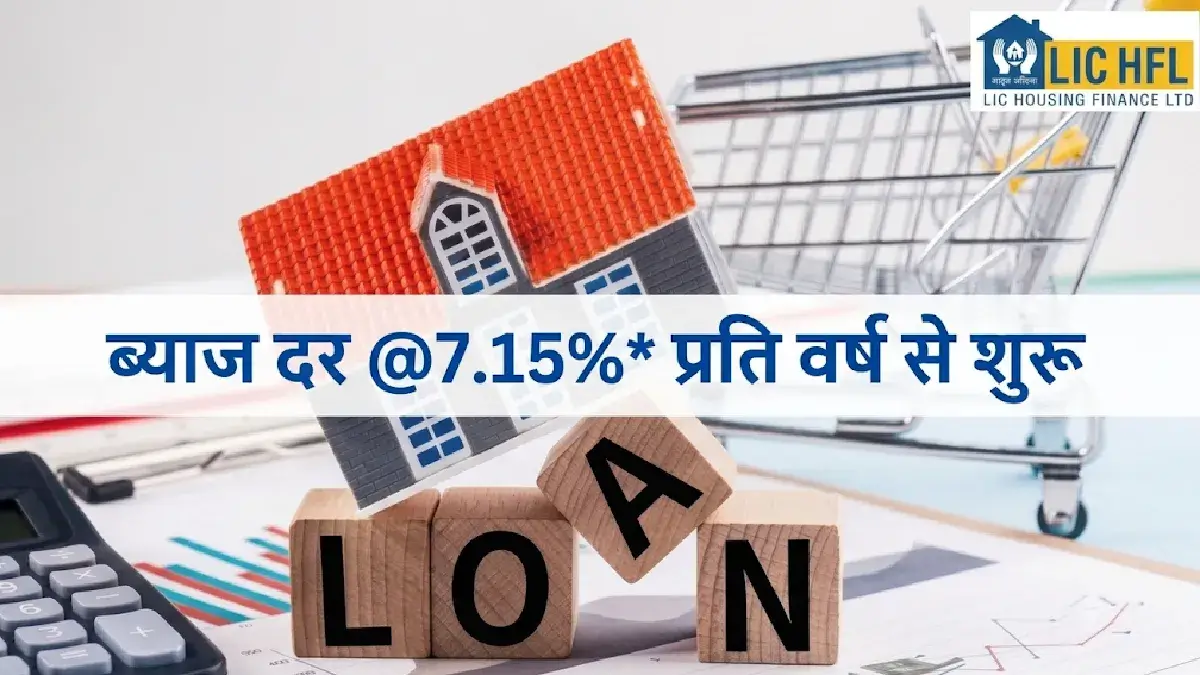
If you are searching for the LIC home loan interest rate in October 2026, here is the key point: LIC Housing Finance (LIC HFL) continues to advertise a starting rate of 7.15% per annum for borrowers with a CIBIL score of 825 and above. However, this rate was published before the Reserve Bank of India\'s repo rate hike on 7 October 2026, and financial news outlets have noted that lenders may revise rates upward in the coming weeks. The rate you see today may not be the rate you are offered tomorrow.
This guide covers what is currently verified about LIC HFL\'s home loan rates, how the RBI\'s policy shift affects borrowers, how to estimate your EMI, who qualifies, what documents you need, and how LIC HFL compares with other major lenders.
LIC Home Loan Interest Rate 2026
As of early October 2026, LIC HFL\'s advertised starting home loan interest rate is 7.15% per annum. This rate applies to loans up to ₹5 crore for borrowers with a CIBIL score of 825 or above, according to LIC HFL\'s published rate card for eligible schemes. The lender uses a tiered pricing structure, with rates increasing as credit scores decrease and loan amounts change.
The critical caveat is timing. The RBI\'s Monetary Policy Committee raised the repo rate by 25 basis points to 5.50% on 7 October 2026—the first hike since 2023—and changed its stance to \"calibrated tightening.\" Because LIC HFL\'s floating rates are linked to its internal benchmark (LHPLR), the repo hike does not automatically trigger an immediate rate change. However, sustained increases in the policy rate typically feed into lenders\' cost of funds over time, and news reports indicate that the 7.15% figure was announced before the repo action and is likely to be revised upward. Borrowers should confirm the current effective rate directly with LIC HFL before applying.
| Particulars | Details |
|---|---|
| Lender | LIC Housing Finance Limited (HFC, not a bank) |
| Advertised starting rate | 7.15% p.a. (pre-repo hike, as of early October 2026) |
| Rate type | Floating, linked to LIC HFL\'s Prime Lending Rate (LHPLR) |
| CIBIL condition for starting rate | 825+ for loans up to ₹5 crore |
| Rate validity | Subject to revision after RBI repo hike; confirm with lender |
| Final applicable rate | Determined by LIC HFL based on profile assessment |
| Recent regulatory change | RBI repo rate hiked to 5.50% on 7 October 2026 |
LIC HFL Interest Rate by CIBIL Score
LIC HFL\'s rate card links interest rates directly to credit score bands. The table below reflects the published structure for loans up to ₹50 lakh, based on LIC HFL\'s official rate card:
| CIBIL Score Range | Interest Rate (p.a.) |
|---|---|
| 825 and above | 7.15% |
| 800 – 824 | 7.25% |
| 775 – 799 | 7.35% |
| 750 – 774 | 7.45% |
| 725 – 749 | 7.65% |
| 700 – 724 | 7.95% |
| 600 – 699 | 8.75% |
| Below 600 | 9.55% |
For loans above ₹50 lakh and up to ₹2 crore, rates are marginally higher within each CIBIL band. For example, a borrower with CIBIL 750–774 pays 7.55% for a loan between ₹50 lakh and ₹2 crore, compared with 7.45% for a loan up to ₹50 lakh.
This tiered structure means the advertised 7.15% is genuinely a floor rate for the most creditworthy borrowers. If your CIBIL score is below 750, your actual rate will be meaningfully higher.
What Determines LIC HFL Home Loan Interest Rates?
LIC HFL prices home loans based on borrower risk and loan characteristics. The advertised 7.15% is the entry point, but several factors can move your actual rate higher.
Credit score is the most direct influence. LIC HFL\'s published rate card explicitly links interest rates to CIBIL score ranges, with each band carrying a different rate. Late payments, defaults, or high credit utilisation can pull your score down and your rate up.
Employment type and income stability matter. LIC HFL\'s own guidance notes that borrowers with steady employment in reputable organisations—government agencies, MNCs, or stable private firms—tend to receive more favourable rates because their repayment potential is assessed as stronger. Self-employed applicants may face a slight premium unless they demonstrate strong business vintage and consistent ITR history.
Loan amount and loan-to-value (LTV) affect pricing. LIC HFL\'s rate card shows different rates across loan slabs, and higher LTV ratios (meaning a smaller down payment) are generally viewed as riskier by lenders.
Property location and profile can influence the final rate. LIC HFL notes that properties in prime developed areas receive lower risk assessments, while properties in underdeveloped or legally complicated locations may attract a higher rate.
Benchmark movements are the final factor. LIC HFL\'s floating rates are linked to its internal LHPLR. When LHPLR changes, your floating rate changes accordingly. This differs from banks like SBI, which link home loans to an external repo-linked benchmark.
LIC HFL Home Loan EMI Calculator 2026
Home Loan EMI Calculator
Live| 📊 Rate | 8.50% |
| ⏱️ Tenure | 20 years |
| 💰 Total Interest | ₹ 0 |
| 💵 Total Payment | ₹ 0 |
Amortization Schedule Monthly
| # | Date | EMI (₹) | Principal (₹) | Interest (₹) | Balance (₹) |
|---|---|---|---|---|---|
| Calculating... | |||||
Before you apply, estimate your monthly outflow. The standard reducing-balance EMI formula is:
EMI = P × r × (1 + r)^n / [(1 + r)^n − 1]
Where:
P = principal loan amount
r = monthly interest rate (annual rate ÷ 12 ÷ 100)
n = total number of monthly instalments (tenure in years × 12)
For the illustrative calculations below, we use an assumed 7.75% annual interest rate over a 20-year tenure. This reflects a realistic post-hike scenario for a borrower who does not qualify for the absolute floor rate. It is not a guaranteed LIC HFL offer.
Worked example: ₹30 lakh at 7.75% for 20 years
P = 30,00,000
r = 7.75 ÷ 12 ÷ 100 = 0.006458
n = 20 × 12 = 240
EMI ≈ ₹24,619
LIC HFL Home Loan EMI for ₹20 Lakh, ₹30 Lakh and ₹50 Lakh
The table below shows estimated EMIs and total interest outgo for three common loan amounts at an illustrative 7.75% annual rate over 20 years. These figures are mathematical illustrations, not LIC HFL offers.
| Loan Amount | Illustrative Rate | Tenure | Estimated EMI | Approx. Total Interest |
|---|---|---|---|---|
| ₹20,00,000 | 7.75% p.a. | 20 years | ₹16,413 | ₹19,39,120 |
| ₹30,00,000 | 7.75% p.a. | 20 years | ₹24,619 | ₹29,08,560 |
| ₹50,00,000 | 7.75% p.a. | 20 years | ₹41,032 | ₹48,47,680 |
Calculations assume a fixed rate for the full tenure, which is not how floating-rate loans actually behave. Actual total interest will vary as rates reset.
A ₹50 lakh loan at 7.75% over 20 years produces an EMI of approximately ₹41,032. If the rate rises to 8.00% after a benchmark revision—a realistic possibility given the October repo hike—the EMI would increase by roughly ₹700 per month, adding up to a meaningful difference over the loan\'s life.
EMI per ₹1 Lakh (at 7.75%):
| Tenure | EMI per ₹1 Lakh |
|---|---|
| 10 years | ₹1,200 |
| 15 years | ₹940 |
| 20 years | ₹821 |
| 25 years | ₹756 |
| 30 years | ₹716 |
Multiply the EMI per ₹1 lakh by your loan amount in lakhs to estimate your monthly EMI. For example: ₹40 lakh at 20 years = ₹821 × 40 = ₹32,840/month.
LIC HFL Home Loan Eligibility Criteria 2026
LIC HFL lends to salaried employees, self-employed professionals, business owners, and NRIs, but eligibility is assessed case by case. The lender\'s FAQ states that eligibility is determined by income, repayment capacity, age, co-applicant income, assets and liabilities, savings history, and the stability of occupation.
Age: The minimum age is typically 21 years at application. Maximum age at loan maturity is generally 70 years for salaried applicants, though pensioners under defined benefit schemes may have different limits. LIC HFL\'s repayment tenure ranges from 5 to 30 years, depending on the scheme and eligibility.
Income and FOIR: LIC HFL allows a Fixed Obligation-to-Income Ratio (FOIR) of up to 60%, meaning up to 60% of your net monthly income can go toward EMIs. This is higher than the 50% threshold common at many banks, which can improve eligibility for borrowers with existing obligations.
Salaried vs self-employed: Salaried applicants generally need salary slips, Form 16, and bank statements. Self-employed applicants need ITRs and financial statements; LIC HFL also considers self-employed individuals without formal ITRs based on a 2-year bank statement evaluation.
Credit history: LIC HFL\'s rate card shows pricing tiers starting from CIBIL 825+, with rates rising as scores decrease. Scores below 600 face significantly higher pricing or difficulty in approval.
Property: The property must meet LIC HFL\'s technical and legal requirements, including clear title and approved construction.
Documents Required for an LIC HFL Home Loan
The exact checklist depends on your profile and the property, but LIC HFL\'s official guidance identifies the core categories:
For all applicants:
Identity proof: PAN card, Aadhaar, passport, or other accepted ID
Address proof: Aadhaar, passport, utility bills, or similar
PAN card and applicable KYC documents
For salaried applicants:
Latest 3 months\' salary slips
6 months\' bank statements
Form 16 or IT returns (where applicable)
Current employer offer letter or employment proof
For self-employed applicants:
ITRs for the last 2–3 years
Audited profit and loss statements and balance sheets
Business proof showing minimum 3 years\' vintage
Business bank statements
Property documents:
Sale agreement or builder\'s agreement
Title deeds
Approved building plan
Occupancy certificate (for ready-to-move properties)
Submitting a complete and accurate set of documents upfront can reduce processing delays.
LIC HFL Home Loan Processing Fees and Other Charges
Processing fees and other charges add to the cost of borrowing and should be factored into your comparison. Industry sources indicate LIC HFL\'s processing fee typically ranges from 0.25% to 0.50% of the loan amount plus GST. The exact amount is stated in the sanction letter and is non-refundable once credit assessment begins.
Other charges to check before signing:
Legal and technical valuation fees: Third-party charges for property inspection and legal verification
Stamp duty and registration: Statutory, paid to government
CERSAI charges: Statutory, for security registration
Prepayment charges: For individual borrowers on floating-rate loans, LIC HFL does not charge prepayment penalties. Fixed-rate loans and non-individual borrowers may have different terms
Late payment penalty: As per LIC HFL\'s policy
Always ask for a written fee schedule before paying anything.
LIC HFL vs SBI vs HDFC Home Loan Interest Rate 2026
Comparing LIC HFL with other major lenders helps put its pricing in context. The table below uses the most recent verified data available as of mid-October 2026.
| Comparison Factor | LIC HFL | SBI | HDFC Bank |
|---|---|---|---|
| Advertised starting rate | 7.15% (pre-hike) | ~7.50% (post-hike, EBLR 8.15%) | ~8.00% (post-hike estimate) |
| Rate type | Floating, linked to LHPLR (internal) | Floating, linked to EBLR/RLLR (external) | Floating, linked to EBLR (external) |
| Benchmark | Internal (LHPLR) | External (repo-linked) | External (repo-linked) |
| Processing fee | 0.25%–0.50% + GST | Per bank schedule | Up to 2% |
| Max tenure | 30 years | 30 years | 30 years |
| Prepayment (floating) | Nil | Nil | Nil |
| Best suited for | Flexible CIBIL, higher FOIR | Lowest rates for high CIBIL scores | Fast processing, large network |
LIC HFL\'s advertised starting rate appears lower than SBI\'s post-hike figure, but this comparison has limits. LIC HFL\'s 7.15% is a floor rate tied to a CIBIL score of 825+ and specific loan slabs, and it predates the October repo hike. SBI\'s EBLR rose to 8.15% effective 15 October 2026, pushing its effective home loan rates higher for many borrowers. LIC HFL may revise its rates in response, narrowing or eliminating the gap.
The lesson: do not choose a lender based solely on the advertised floor rate. Compare the rate you are actually offered, the processing fee, the benchmark behaviour, and your total interest outgo over the intended tenure.
Is LIC HFL a Good Option for Homebuyers in 2026?
LIC HFL can be a reasonable option for certain borrowers, but it is not universally the best choice.
Where LIC HFL may appeal:
Borrowers with CIBIL scores between 600 and 750 who may find LIC HFL\'s tiered pricing more accommodating than banks with stricter cut-offs
Self-employed applicants who value LIC HFL\'s willingness to consider borrowers without formal ITRs, based on bank statement evaluation
Borrowers seeking long tenures (up to 30 years) and no prepayment charges on floating-rate loans
Those who prioritise a higher FOIR (up to 60%) for improved eligibility
Where caution is warranted:
The 7.15% starting rate is not available to everyone; if your CIBIL score is below 750, your actual rate will be meaningfully higher
LIC HFL\'s floating rate is linked to an internal benchmark (LHPLR), not an external repo-linked benchmark. Rate changes depend on LIC HFL\'s decisions as well as market conditions
The October 2026 repo hike may lead to higher rates across lenders, including LIC HFL
SBI and other banks may offer competitive rates for highly creditworthy borrowers, especially after their own rate revisions
The right choice depends on your actual sanctioned offer, not on headline rates.
How to Apply for an LIC HFL Home Loan
Review the official product and eligibility criteria on LIC HFL\'s website or at a branch. Confirm which scheme suits your profile (salaried, self-employed, professional, pensioner, NRI).
Estimate your loan amount and EMI using LIC HFL\'s official calculator or the formula above, based on the current rate you are quoted.
Gather income, KYC, and property documents according to the checklist provided by LIC HFL.
Submit the application through an officially supported channel—online, at a branch, or through an authorised representative. Avoid unofficial intermediaries promising guaranteed approval.
Complete verification and property assessment. LIC HFL will check your credit, income, and property documents, and may arrange technical and legal valuations.
Review the sanction terms carefully. Check the interest rate (and whether it is fixed or floating), processing fee, prepayment conditions, and all other charges before accepting.
Proceed to disbursement only after the requirements in the sanction letter are satisfied and you have understood the repayment schedule.
Frequently Asked Questions
What is the LIC HFL home loan interest rate in October 2026?
The advertised starting rate is 7.15% p.a. for borrowers with CIBIL 825+ and loans up to ₹5 crore. However, this rate was published before the RBI\'s repo hike on 7 October 2026 and may be revised. Confirm the current effective rate with LIC HFL before applying.
What CIBIL score is required for the 7.15% rate?
A CIBIL score of 825 or above is required for the 7.15% starting rate on loans up to ₹5 crore. Lower scores correspond to higher rates, as shown in the rate table above.
Does LIC HFL offer home loans to salaried employees?
Yes. Salaried employees from government, PSU, MNC, and private sector organisations are eligible, subject to meeting income, credit, and documentation requirements.
Can self-employed individuals apply for an LIC HFL home loan?
Yes. Self-employed professionals and business owners can apply. LIC HFL also considers self-employed individuals without formal ITRs based on a 2-year bank statement evaluation.
What is the EMI for a ₹50 lakh LIC HFL home loan?
At an illustrative 7.75% rate over 20 years, the EMI is approximately ₹41,032. At a higher post-hike rate, the EMI will be higher. At the floor rate of 7.15% over 30 years, the EMI would be lower, but few borrowers qualify for that rate.
What documents are required for an LIC HFL home loan?
Core documents include identity proof, address proof, PAN, income proof (salary slips/Form 16 or ITRs/financials), and property documents. LIC HFL may request additional documents based on your profile.
Does LIC HFL charge a processing fee?
Yes. Processing fees typically range from 0.25% to 0.50% of the loan amount plus GST. The exact amount is stated in the sanction letter and is non-refundable once credit assessment begins.
Is LIC HFL cheaper than SBI for a home loan?
LIC HFL\'s advertised starting rate (7.15%) is lower than SBI\'s post-hike effective rates (EBLR at 8.15% plus spreads), but these are floor rates for different borrower profiles and the LIC HFL rate may be revised. A direct comparison requires the specific rates offered to you by each lender, including fees.
How does the RBI repo hike affect LIC HFL home loans?
LIC HFL\'s floating rates are linked to its internal LHPLR, not directly to the repo rate. The repo hike does not automatically change your rate, but sustained policy tightening typically feeds into lenders\' cost of funds over time, and LIC HFL may revise its LHPLR in response.
What is the maximum tenure for an LIC HFL home loan?
The maximum repayment tenure is up to 30 years, depending on the scheme and the borrower\'s age at maturity.