Table of Contents
- Quick Summary: Lowest Home Loan Interest Rates in India 2026
- Top 10 Banks with Lowest Home Loan Interest Rates in 2026
- Home Loan EMI Comparison � ?30 Lakh, ?50 Lakh, and ?75 Lakh
- Best Home Loan Interest Rates for Salaried Employees
- Best Home Loan Interest Rates for Government Employees
- Best Home Loan Interest Rates for Women Borrowers
- PSU Banks vs Private Banks Home Loan Interest Rates
- Fixed vs Floating Home Loan Interest Rates � Which Is Bet...
- Factors Affecting Home Loan Interest Rates
- How to Get the Lowest Home Loan Interest Rate
- Home Loan Processing Fees Comparison
- Latest RBI Repo Rate Impact on Home Loan Interest Rates
- How to Compare Home Loans Before Applying
- Frequently Asked Questions
- Conclusion
Buying a home is one of the most significant financial decisions you will ever make. For most Indians, a home loan is the bridge that turns this dream into reality. But here is the truth — even a minor difference in your interest rate can translate into lakhs of rupees in additional savings or costs over the loan tenure.
With the Reserve Bank of India (RBI) holding the repo rate steady at 5.25% after the June 2026 Monetary Policy Committee meeting, home loan interest rates have stabilized across the board. However, rates still vary significantly across banks — from as low as 7.10% to over 13% — depending on the lender, your credit profile, and the loan amount.
That is why comparing home loan interest rates before applying is not just advisable — it is essential. This comprehensive guide brings you the lowest home loan interest rates in India for 2026, bank-wise comparisons, EMI calculations, eligibility insights, and practical tips to help you secure the best deal.
Quick Summary: Lowest Home Loan Interest Rates in India 2026
? Featured Snippet: Which bank offers the lowest home loan interest rate in India in 2026?
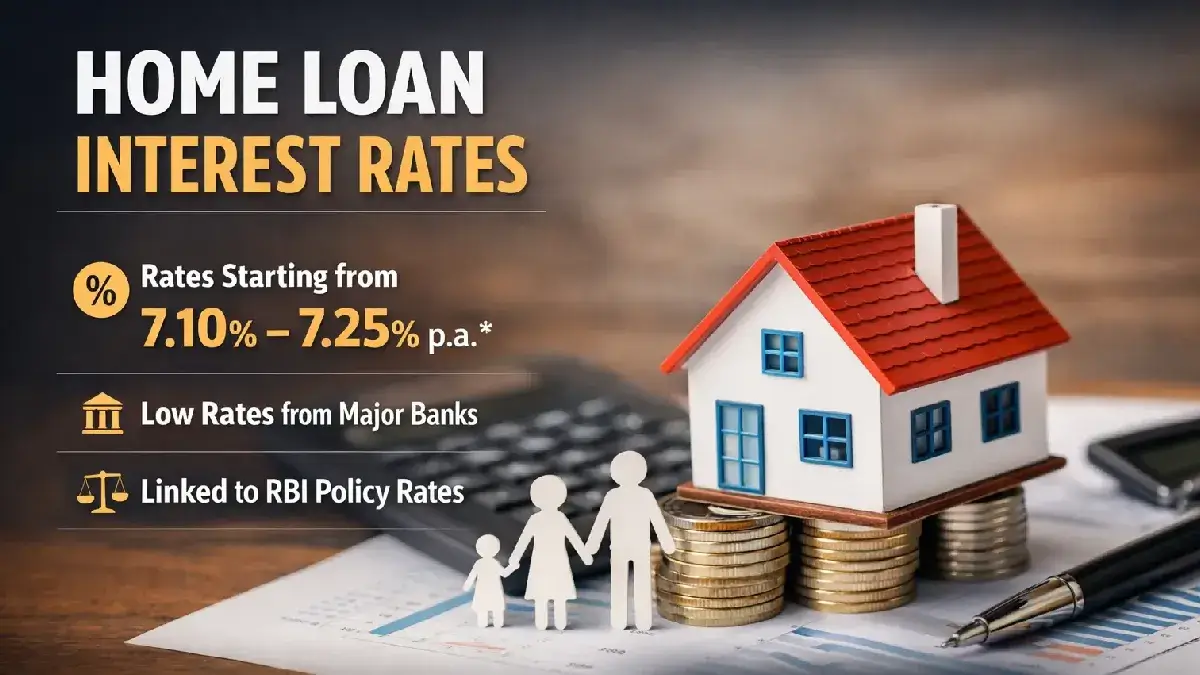
Bank of India offers the lowest home loan interest rate in India in 2026 at 7.10% per annum, followed closely by Central Bank of India, Indian Overseas Bank, and Bank of Maharashtra at the same rate. Among housing finance companies, LIC Housing Finance offers the lowest rate at 7.15% per annum. State Bank of India, the country's largest lender, offers rates starting from 7.25% for eligible borrowers.
Top 10 Banks with Lowest Home Loan Interest Rates in 2026
Based on the latest data from June 2026, here are the top 10 lenders offering the most competitive home loan interest rates:
Public Sector Banks (PSU Banks)
Private Sector Banks
Housing Finance Companies (HFCs)
Home Loan EMI Comparison – ?30 Lakh, ?50 Lakh, and ?75 Lakh
Your Equated Monthly Instalment (EMI) depends on three factors: loan amount, interest rate, and tenure. Here is how EMIs vary across different banks for a 20-year tenure.
?30 Lakh Home Loan – EMI Comparison
| Bank | Interest Rate | Monthly EMI | Total Interest | Total Payment |
|---|---|---|---|---|
| Bank of India | 7.10% | ?23,418 | ?32,20,320 | ?62,20,320 |
| Canara Bank | 7.15% | ?23,512 | ?32,42,880 | ?62,42,880 |
| SBI | 7.25% | ?23,721 | ?32,92,… | ?62,92,… |
| Bank of Baroda | 7.20% | ?23,617 | ?32,68,080 | ?62,68,080 |
| LIC Housing Finance | 7.15% | ?23,512 | ?32,42,880 | ?62,42,880 |
| ICICI Bank | 7.45% | ?24,049 | ?33,71,760 | ?63,71,760 |
| HDFC Bank | 7.75% | ?24,609 | ?35,06,160 | ?65,06,160 |
| Axis Bank | 8.00% | ?25,093 | ?36,22,320 | ?66,22,320 |
Note: EMI calculated for 20-year tenure. Actual EMI may vary based on exact rate and processing fees.
?50 Lakh Home Loan – EMI Comparison
| Bank | Interest Rate | Monthly EMI | Total Interest | Total Payment |
|---|---|---|---|---|
| Bank of India | 7.10% | ?39,031 | ?53,67,200 | ?1,03,67,200 |
| Canara Bank | 7.15% | ?39,187 | ?53,72,800 | ?1,03,72,800 |
| SBI | 7.25% | ?39,535 | ?54,87,200 | ?1,04,87,200 |
| LIC Housing Finance | 7.15% | ?39,187 | ?53,72,800 | ?1,03,72,800 |
| ICICI Bank | 7.45% | ?40,082 | ?56,19,680 | ?1,06,19,680 |
| HDFC Bank | 7.75% | ?41,015 | ?58,43,600 | ?1,08,43,600 |
| Axis Bank | 8.00% | ?41,822 | ?60,37,200 | ?1,10,37,200 |
?75 Lakh Home Loan – EMI Comparison
| Bank | Interest Rate | Monthly EMI | Total Interest | Total Payment |
|---|---|---|---|---|
| Bank of India | 7.10% | ?58,547 | ?80,51,200 | ?1,55,51,200 |
| Canara Bank | 7.15% | ?58,781 | ?80,67,600 | ?1,55,67,600 |
| SBI | 7.25% | ?59,303 | ?82,31,200 | ?1,57,31,200 |
| LIC Housing Finance | 7.15% | ?58,781 | ?80,67,600 | ?1,55,67,600 |
| ICICI Bank | 7.45% | ?60,123 | ?84,29,520 | ?1,59,29,520 |
| HDFC Bank | 7.75% | ?61,523 | ?87,65,400 | ?1,62,65,400 |
| Axis Bank | 8.00% | ?62,733 | ?90,55,800 | ?1,65,55,800 |
Key Insight: On a ?75 lakh loan over 20 years, choosing Bank of India (7.10%) over Axis Bank (8.00%) can save you over ?10 lakh in total interest payments.
Best Home Loan Interest Rates for Salaried Employees
Salaried employees are generally considered low-risk borrowers by banks, making them eligible for some of the most competitive interest rates. If you have a stable job with a reputed company and a CIBIL score above 750, you can access the lowest rates available.
Key Banks for Salaried Employees
Requirements for Salaried Borrowers
Minimum work experience: 1–2 years (varies by bank)
Minimum monthly income: ?25,000 in metro cities, ?15,000 in non-metro areas
CIBIL score: 750+ recommended for best rates
Age: 21 to 65 years (at loan maturity)
Documents: Salary slips (last 3 months), Form 16, bank statements
Expert Tip
\"Salaried employees with a CIBIL score of 800 or above can often negotiate rates lower than the published starting rates. Banks are willing to offer concessions to retain high-quality borrowers.\" — BankerMart Research Team
Best Home Loan Interest Rates for Government Employees
Government employees enjoy some of the most privileged home loan terms in India. Banks view government jobs as exceptionally stable, which translates into lower risk and, consequently, lower interest rates.
SBI Privilege Home Loan – The Best Offer for Government Employees
State Bank of India offers the SBI Privilege Home Loan exclusively for government employees, providing a guaranteed 0.25% interest rate concession over the standard rate.
Interest Rate: Starting from 7.25% (effective rate for government employees)
Processing Fee: Zero (100% waived)
Maximum Tenure: Up to 30 years
Who Qualifies: Central Government, State Government, PSU employees, and public sector bank employees
Government Employee Rates Comparison
Note: Women government employees can get a combined concession of 0.30% (0.25% Privilege + 0.05% women concession) under SBI's scheme.
Eligibility for Government Employee Home Loans
Category: Central/State Government, PSU, Public Sector Bank, Autonomous Bodies
Service: Confirmed/permanent employee
Age: 18 to 75 years (at maturity)
CIBIL Score: 750+ recommended
Documentation: Department ID, joining letter, salary slips
Best Home Loan Interest Rates for Women Borrowers
Women borrowers receive preferential treatment from most Indian banks, with dedicated interest rate concessions ranging from 0.05% to 0.10% below standard rates.
Top Banks Offering Women Concessions
Why Women Get Better Rates
Most banks offer a 0.05% interest rate concession to women who are the primary applicants or first co-applicants on a home loan. This may seem small, but on a ?50 lakh loan over 30 years, this concession can save you over ?65,000 in total interest.
Additional Benefits for Women
Stamp Duty Savings: Many states offer 1%–2% lower stamp duty for properties registered in a woman's name.
PMAY Subsidy: Eligible women borrowers can get interest subsidies of up to ?1.80 lakh under Pradhan Mantri Awas Yojana.
Higher Eligibility: Adding a woman as a co-applicant increases the combined income and boosts loan eligibility.
PSU Banks vs Private Banks Home Loan Interest Rates
One of the most common dilemmas for home loan borrowers is choosing between public sector banks (PSUs) and private banks. Here is an honest comparison:
Rate Comparison: PSU Banks vs Private Banks
| Bank Type | Starting Rate | Average Rate | Processing Fee | Approval Speed |
|---|---|---|---|---|
| PSU Banks | 7.10% – 7.25% | 7.50% – 8.50% | 0.35% – 0.50% | Moderate (7–15 days) |
| Private Banks | 7.30% – 8.00% | 7.75% – 9.50% | 0.50% – 1% | Faster (3–7 days) |
| HFCs | 7.15% – 7.75% | 7.50% – 8.50% | 0.25% – 0.50% | Moderate (5–10 days) |
PSU Banks – Advantages
Lower starting rates: Most PSU banks offer rates from 7.10% onwards
Lower processing fees: Typically 0.35% with caps
No prepayment penalties: Most PSU banks charge nil foreclosure fees
Wider branch network: SBI alone has over 22,000 branches
PSU Banks – Disadvantages
Slower processing: Can take 10–15 days for approval
Stricter documentation: Extensive paperwork required
Less flexibility: Fewer product variations
Private Banks – Advantages
Faster approval: Often 3–7 days
Better digital experience: Superior mobile apps and online services
Flexible products: More loan variants and customization options
Negotiation room: More willing to offer concessions
Private Banks – Disadvantages
Higher rates: Starting rates are generally 0.20%–0.50% higher
Higher processing fees: Often 1% or more
Prepayment charges: May apply on fixed-rate loans
Verdict
For rate-sensitive borrowers, PSU banks offer the lowest home loan interest rates. However, if speed and convenience are your priorities, private banks may be worth the slightly higher cost.
Fixed vs Floating Home Loan Interest Rates – Which Is Better in 2026?
This is one of the most important decisions you will make. Here is what you need to know:
Floating Rate Home Loans
Linked to: RBI repo rate or bank's MCLR/EBLR
Advantages: Lower initial rates, benefits from rate cuts
Disadvantages: EMIs can increase if rates rise
Fixed Rate Home Loans
Linked to: Bank's fixed rate policy
Current rates: 8.50% – 12.50%
Advantages: EMIs remain constant throughout the tenure
Disadvantages: Higher rates, no benefit from rate cuts
The 2026 Scenario
With the RBI repo rate currently at 5.25% and analysts expecting rates to remain stable, floating rate loans are significantly cheaper than fixed-rate options. Most experts recommend floating-rate home loans in the current environment, especially if you plan to stay in the loan for 10+ years.
Expert Perspective
\"Given that the RBI has already cut rates by 125 basis points since early 2025 and is now in a neutral stance, floating-rate home loans offer the best value. Fixed-rate loans make sense only if you believe interest rates will rise sharply in the coming years.\" — BankerMart Research Team
Factors Affecting Home Loan Interest Rates
Understanding what determines your home loan interest rate can help you improve your chances of securing the lowest possible rate. Here are the key factors:
1. CIBIL Score (Most Important)
Your CIBIL score is the single most important factor determining your interest rate. Banks typically offer their lowest rates to borrowers with scores of 750 and above.
| CIBIL Score | Impact on Rate |
|---|---|---|
| 800+ | Lowest rate available |
| 750 – 799 | Slightly higher rate (0.10% – 0.25% premium) |
| 700 – 749 | Moderate rate (0.25% – 0.50% premium) |
| Below 700 | Higher rate (0.50% – 1%+ premium) |
2. Income and Employment Type
Salaried employees with stable jobs at reputed companies get better rates than self-employed individuals. Government employees get the best rates.
3. Loan Amount
Different loan slabs attract different interest rates. Generally, loans between ?30 lakh and ?75 lakh have competitive rates, while smaller loans may have higher rates.
4. Loan Tenure
Longer tenures often have slightly higher rates. Shorter tenures (5–10 years) typically attract lower rates.
5. Property Type
Approved projects from reputed builders get better rates than under-construction or less-known projects.
6. Existing Liabilities
If you have existing loans or high credit card utilization, banks may view you as a higher-risk borrower and charge a higher rate.
7. Relationship with the Bank
Existing customers with salary accounts, fixed deposits, or other banking relationships often get preferential rates.
How to Get the Lowest Home Loan Interest Rate
Securing the lowest possible interest rate requires preparation and strategy. Here are actionable tips:
1. Improve Your CIBIL Score
Pay all credit card bills and loan EMIs on time
Keep credit utilization below 30%
Check your credit report regularly for errors
Avoid multiple loan applications in a short period
A higher credit score can reduce your home loan interest rate by 0.5% – 1% .
2. Increase Your Down Payment
A larger down payment reduces the Loan-to-Value (LTV) ratio, which can help you secure a better rate.
| Loan Amount | Maximum LTV |
|---|---|
| Up to ?30 lakh | 90% |
| ?30 lakh – ?75 lakh | 80% |
| Above ?75 lakh | 75% |
3. Add a Co-Applicant
Adding a co-applicant with a good credit score and stable income can boost your loan eligibility and potentially lower your rate.
4. Choose the Right Tenure
While a longer tenure means lower EMIs, it also means higher total interest. Balance affordability with interest savings.
5. Compare Multiple Banks
Never settle for the first offer. Use BankerMart to compare rates across 15+ banks and housing finance companies.
6. Negotiate with Your Bank
If you have a good credit score and a stable job, you can negotiate. Ask your bank for a rate concession—many banks are willing to offer 0.05% – 0.10% off to retain quality borrowers.
7. Consider Balance Transfer
If you already have a home loan, check if you can transfer it to another bank offering a lower rate. The savings on interest often outweigh the transfer fees.
Home Loan Processing Fees Comparison
Processing fees can add significantly to your loan cost. Here is a comparison of processing fees across major lenders:
| Bank | Processing Fee | Maximum Cap |
|---|---|---|
| SBI | 0.35% + GST | ?10,000 + GST |
| Bank of India | 0.35% – 1% + GST | Varies |
| Canara Bank | 0.50% – 1% + GST | Varies |
| Bank of Baroda | 0.50% – 1% + GST | Varies |
| ICICI Bank | 0.50% – 1% + GST | Varies |
| HDFC Bank | 0.50% + GST | ?4,000 – ?10,000 |
| Axis Bank | 1% + GST | ?10,000 minimum |
| LIC Housing Finance | 0.25% – 0.50% + GST | Varies |
| PNB | 0.35% + GST | ?8,500 + GST |
Hidden Charges to Watch For
Legal and Valuation Fees: Charged at actual cost
CERSAI Charges: Typically ?50 – ?100
Prepayment Penalties: Nil for floating-rate loans, may apply for fixed-rate loans
Stamp Duty and Registration: State-wise, not included in loan
Latest RBI Repo Rate Impact on Home Loan Interest Rates
The RBI repo rate is the most significant driver of home loan interest rates in India. Here is what you need to know for 2026:
Current Scenario
Rate Cuts Since Early 2025: 125 basis points (from 6.50% to 5.25%)
How Repo Rate Affects Your Home Loan
Floating Rate Loans: Directly linked to repo rate via EBLR or RLLR. Rate changes are passed on to borrowers.
Fixed Rate Loans: Unaffected by repo rate changes.
MCLR-linked Loans: Also influenced, but with a lag.
Impact on Borrowers
New Borrowers: Continue to benefit from the cumulative 125 bps rate cut
Existing Borrowers: EMIs have already been reduced; no immediate change expected
Future Outlook: Analysts expect rates to remain stable in the near term
Expert Insight
\"The RBI's decision to hold rates reflects global economic uncertainties. For home loan borrowers, this means stability—neither a reduction nor an increase in EMIs in the near term.\" — BankerMart Research Team
How to Compare Home Loans Before Applying
Before you sign on the dotted line, use this checklist to compare home loans effectively:
Home Loan Comparison Checklist
| Factor | Checklist Item |
|---|---|
| ? Interest Rate | Is it fixed or floating? What is the starting rate? |
| ? Processing Fee | What is the percentage? Is there a cap? |
| ? Prepayment Charges | Are there penalties for early repayment? |
| ? Loan Tenure | Up to how many years can you stretch? |
| ? LTV Ratio | How much of the property value will the bank finance? |
| ? Special Benefits | Are there concessions for women, government employees, or first-time buyers? |
| ? Hidden Charges | Legal fees, valuation fees, CERSAI charges—ask upfront |
| ? Approval Time | How long does the bank take to process? |
| ? Customer Service | Reviews from existing borrowers |
| ? Balance Transfer | Is the bank open to balance transfers with competitive rates? |
Step-by-Step Comparison Process
Step 1: Check the interest rate table (provided above)
Step 2: Calculate your EMI for different rates using an EMI calculator
Step 3: Compare processing fees and other charges
Step 4: Check eligibility for special concessions (women, government, etc.)
Step 5: Review customer feedback and bank reputation
Step 6: Shortlist 2–3 banks and apply
Frequently Asked Questions
Home Loan EMI Calculator
Live| 📊 Rate | 8.50% |
| ⏱️ Tenure | 20 years |
| 💰 Total Interest | ₹ 0 |
| 💵 Total Payment | ₹ 0 |
Amortization Schedule Monthly
| # | Date | EMI (₹) | Principal (₹) | Interest (₹) | Balance (₹) |
|---|---|---|---|---|---|
| Calculating... | |||||
1. Which bank has the lowest home loan interest rate in India 2026?
Bank of India offers the lowest home loan interest rate at 7.10% per annum in 2026, followed by Central Bank of India, Indian Overseas Bank, and Bank of Maharashtra at the same rate. Among housing finance companies, LIC Housing Finance offers the lowest rate at 7.15%.
2. Is SBI cheaper than HDFC for home loans?
Yes, SBI is significantly cheaper than HDFC Bank. SBI offers home loans starting at 7.25%, while HDFC Bank starts at 7.75% .
3. What CIBIL score is required for the lowest home loan rate?
A CIBIL score of 750 or above is typically required to access the lowest home loan interest rates. Scores above 800 can help you negotiate even better terms.
4. Which bank gives the fastest home loan approval?
Private banks like HDFC Bank, ICICI Bank, and Axis Bank generally offer faster approval times (3–7 days) compared to PSU banks (7–15 days).
5. Fixed or floating home loan rate—which is better in 2026?
With the RBI repo rate at 5.25% and expected to remain stable, floating-rate loans are currently offering significantly lower rates and are generally recommended.
6. Do women get a lower home loan interest rate?
Yes, most banks offer a 0.05% to 0.10% interest rate concession for women borrowers. Some banks like Canara Bank also offer 100% processing fee waivers under their women's schemes.
7. What is the home loan processing fee for SBI?
SBI charges 0.35% of the loan amount + GST, with a minimum of ?2,000 + GST and a maximum of ?10,000 + GST.
8. Can I transfer my existing home loan to another bank?
Yes, home loan balance transfer is allowed. You can move your loan to another bank offering a lower interest rate. The transfer fees typically range from 0.5% to 1% of the outstanding amount.
9. How much can I save by choosing the lowest rate over 20 years?
On a ?50 lakh loan over 20 years, choosing Bank of India (7.10%) over Axis Bank (8.00%) can save you over ?6.7 lakh in total interest.
10. Are government employees eligible for lower home loan rates?
Yes, government employees are eligible for special schemes like SBI Privilege Home Loan, which offers a 0.25% concession and zero processing fees.
11. What is the maximum home loan tenure in India?
The maximum home loan tenure in India is up to 30 years, subject to the borrower's age (loan must be repaid by age 70–75 years depending on the bank).
12. Does the RBI repo rate affect existing home loan EMIs?
Yes, if your loan is linked to the repo rate or EBLR, changes in the repo rate will affect your EMI. However, with the repo rate unchanged at 5.25%, EMIs are expected to remain stable.
13. What documents are required for a home loan?
Key documents include identity proof (Aadhaar, PAN), address proof, income proof (salary slips/IT returns), property documents, and bank statements.
14. Can self-employed individuals get home loans at low rates?
Yes, but self-employed individuals may face slightly higher rates (0.25% – 0.50% premium) compared to salaried employees. Maintaining a CIBIL score above 750 helps.
15. Is there any tax benefit on home loans?
Yes. You can claim deductions of up to ?1.5 lakh under Section 80C (principal) and up to ?2 lakh under Section 24(b) (interest) per financial year.
16. What is the difference between EBLR and MCLR?
EBLR (External Benchmark Lending Rate) is linked to the RBI repo rate and is more transparent. MCLR (Marginal Cost of Funds-based Lending Rate) is an internal benchmark set by banks. EBLR is currently more common and responsive to rate changes.
17. Can I get a home loan without a CIBIL score?
Yes, but you may need a co-applicant with a good CIBIL score or collateral. The interest rate will likely be higher.
18. What is the PMAY subsidy and who is eligible?
PMAY (Pradhan Mantri Awas Yojana) provides interest subsidies of up to ?1.80 lakh for first-time homebuyers in affordable housing segments. Women and economically weaker sections are prioritized.
19. How long does the home loan approval process take?
Approval times vary: 3–7 days for private banks and 7–15 days for PSU banks. The timeline depends on document completeness and property verification.
20. Which housing finance company offers the lowest rate?
LIC Housing Finance offers the lowest rate among housing finance companies at 7.15% per annum in 2026.
Conclusion
Finding the lowest home loan interest rate in India in 2026 requires careful research, comparison, and preparation. As we have seen, rates vary significantly across lenders—from 7.10% at Bank of India to over 8% at some private banks.
The key takeaways from this guide:
PSU banks offer the lowest rates: Bank of India, Canara Bank, SBI, and others lead the market with rates starting from 7.10%–7.25%.
Women and government employees get extra benefits: Concessions ranging from 0.05% to 0.30% are available.
Your CIBIL score matters: A score of 750+ unlocks the best rates.
Processing fees and hidden charges vary: Compare total cost, not just interest rates.
Use BankerMart to compare: Don't settle for the first offer—compare multiple lenders before applying.
The difference between 7.10% and 8.00% on a ?50 lakh loan over 20 years is over ?6.7 lakh in extra interest. That is money that could have gone towards your child's education, a home renovation, or your retirement savings.
Take the time to compare. Use the tables, checklists, and tips in this guide. And when you are ready, let BankerMart help you find the best home loan deal for your unique situation.