Table of Contents
- What is SBI Home Loan Eligibility Based on Property Value?
- How SBI Calculates Home Loan Eligibility
- Property Value vs Loan Eligibility
- RBI LTV Ratio Rules for Home Loans 2026
- SBI Maximum Loan Amount Based on Property Value
- SBI Home Loan EMI Table
- Down Payment Calculator
- Property Value Calculator
- Income vs Property Value
- Salary vs Eligible Loan Amount
- Required CIBIL Score
- Documents Required for SBI Home Loan
- Eligible Property Types
- SBI Home Loan Interest Rates 2026
- SBI Home Loan Charges
- Property Verification Process
- Common Reasons for Rejection
- Tips to Increase Eligibility
- SBI vs HDFC vs ICICI vs PNB vs Bank of Baroda
- Frequently Asked Questions (FAQs)
- Conclusion
EMI Calculator
Home Loan EMI Calculator
Live| 📊 Rate | 8.50% |
| ⏱️ Tenure | 20 years |
| 💰 Total Interest | ₹ 0 |
| 💵 Total Payment | ₹ 0 |
Amortization Schedule Monthly
| # | Date | EMI (₹) | Principal (₹) | Interest (₹) | Balance (₹) |
|---|---|---|---|---|---|
| Calculating... | |||||
Buying a home is one of the most significant financial decisions you will ever make. And when it comes to securing a home loan, one of the first questions that comes to mind is: How much loan can I actually get?
If you are considering a home loan from the State Bank of India (SBI) – India’s largest public sector bank – the answer depends largely on one critical factor: the value of the property you wish to buy. Your property's market value, combined with RBI's Loan-to-Value (LTV) guidelines, determines the maximum loan amount SBI can sanction. This, in turn, decides your down payment requirement and monthly EMI.
This comprehensive guide explains everything you need to know about SBI home loan eligibility based on property value. We will break down the RBI LTV rules for 2026, show you exactly how much loan you can get for properties at different price points, explain the down payment calculation, and provide real-life examples. We will also show you how BankerMart – an independent home loan comparison platform – can help you compare SBI's offer with other banks to make an informed borrowing decision.
What is SBI Home Loan Eligibility Based on Property Value?
When you apply for a home loan, SBI does not simply approve the amount you request. Instead, the bank evaluates multiple factors, including your income, credit score, age, and existing liabilities. However, the property value is the foundation upon which the maximum loan amount is built.
SBI home loan eligibility based on property value refers to the maximum loan amount you can get, calculated as a percentage of the property's value. This percentage is governed by the RBI's Loan-to-Value (LTV) ratio guidelines. The LTV ratio determines how much the bank can lend you, and the remaining amount becomes your mandatory down payment.
For example, if a property is valued at ₹50 lakh and the applicable LTV ratio is 80%, SBI can lend you up to ₹40 lakh. You will need to arrange the remaining ₹10 lakh as a down payment from your own sources.
Important Note: BankerMart is an independent comparison platform, not a lender. We help you compare home loan offers from SBI and other banks to find the best deal for your profile. Final loan approval always depends on SBI's credit policy and property verification.
How SBI Calculates Home Loan Eligibility
SBI uses a multi-step process to determine your final loan eligibility. Here is how it works:
Step 1: Property Value Assessment
SBI empanels an independent valuer to assess the property's market value or agreement value, whichever is lower. This assessed value becomes the basis for loan calculation.
Step 2: Apply LTV Ratio
Based on the loan amount slab, SBI applies the RBI-prescribed LTV ratio. This gives the maximum loan amount you can get against that property.
Step 3: Income & Repayment Capacity Check
SBI then checks whether your income is sufficient to repay the loan. The bank uses the FOIR (Fixed Obligation to Income Ratio) – typically 40% to 55% of your monthly income – to determine the maximum EMI you can afford .
Step 4: Credit Score Check
Your CIBIL score must meet SBI's minimum requirement (typically 700-750+) . A higher score can help you secure a higher loan amount and better interest rate.
Step 5: Age & Tenure
Your age determines the maximum repayment tenure. SBI offers loans up to 30 years, but the tenure is capped so that you do not exceed 70 years of age at loan maturity .
Step 6: Final Sanction
The final loan amount is the lower of:
Maximum loan as per LTV
Maximum loan as per income eligibility
Property Value vs Loan Eligibility
The relationship between property value and loan eligibility is direct and straightforward. The higher the property value, the higher the potential loan amount – subject to the LTV ratio and your income eligibility.
Here is a simplified view:
| Property Value | Maximum LTV | Maximum Loan | Minimum Down Payment |
|---|---|---|---|
| ₹10 Lakh | 90% | ₹9 Lakh | ₹1 Lakh |
| ₹20 Lakh | 90% | ₹18 Lakh | ₹2 Lakh |
| ₹30 Lakh | 90% | ₹27 Lakh | ₹3 Lakh |
| ₹40 Lakh | 80% | ₹32 Lakh | ₹8 Lakh |
| ₹50 Lakh | 80% | ₹40 Lakh | ₹10 Lakh |
| ₹60 Lakh | 80% | ₹48 Lakh | ₹12 Lakh |
| ₹75 Lakh | 80% | ₹60 Lakh | ₹15 Lakh |
| ₹1 Crore | 75% | ₹75 Lakh | ₹25 Lakh |
| ₹1.5 Crore | 75% | ₹1.125 Crore | ₹37.5 Lakh |
| ₹2 Crore | 75% | ₹1.5 Crore | ₹50 Lakh |
| ₹3 Crore | 75% | ₹2.25 Crore | ₹75 Lakh |
| ₹5 Crore | 75% | ₹3.75 Crore | ₹1.25 Crore |
Expert Tip: The property value considered by SBI may be lower than the price you agreed with the seller. If the bank's valuer assesses the property at a lower value, your loan amount will be reduced, and you will need to cover the gap from your pocket.
RBI LTV Ratio Rules for Home Loans 2026
The RBI mandates maximum LTV ratios for all home loans in India. These rules are designed to ensure that borrowers have some \"skin in the game\" through a mandatory down payment .
Current RBI LTV Guidelines 2026
| Loan Amount Slab | Maximum LTV | Minimum Down Payment |
|---|---|---|
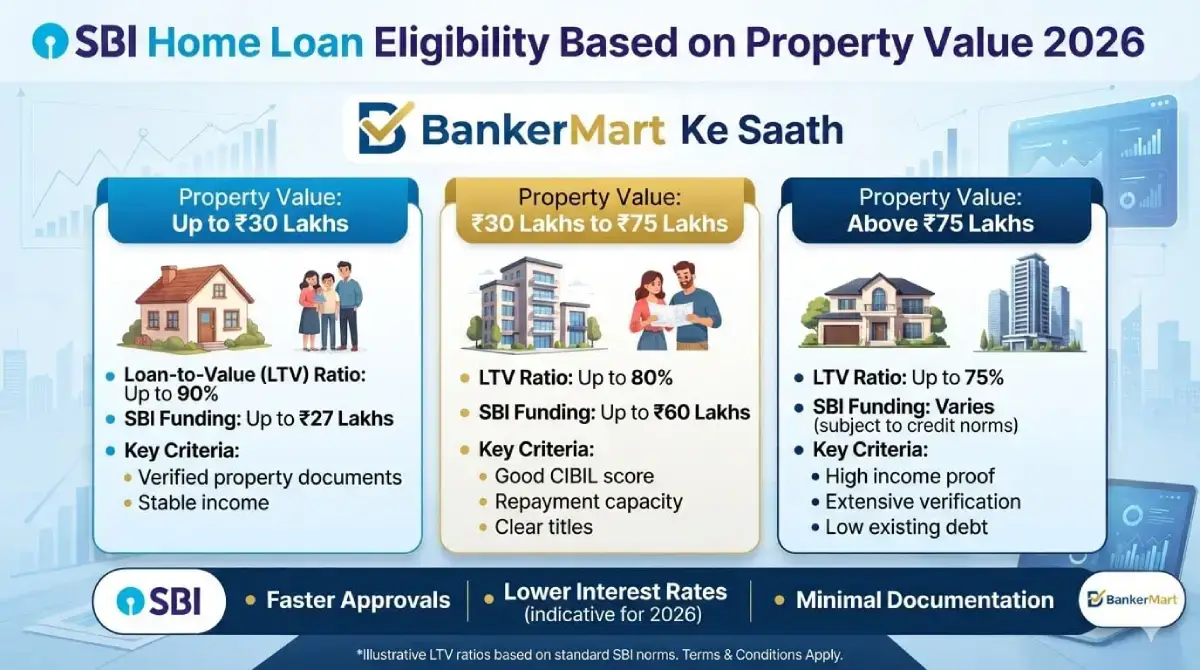
| Up to ₹30 Lakh | 90% | 10% |
| ₹30 Lakh – ₹75 Lakh | 80% | 20% |
| Above ₹75 Lakh | 75% | 25% |
Source: RBI guidelines as applicable in 2026
Important Points About LTV Rules
Slab-Based Application: The LTV slab is applied to the entire loan amount, not just the portion above a threshold. For example, if you borrow ₹76 lakh, the 75% LTV applies to the full ₹76 lakh, not 80% on the first ₹75 lakh and 75% on the remainder .
Stamp Duty & Registration Excluded: Lenders cannot include stamp duty or registration charges in the LTV ratio unless the property is worth less than ₹10 lakh .
Bank Can Apply Stricter LTV: Individual lenders like SBI can apply stricter LTV ratios than the RBI maximum, especially for older properties or resale flats not on their approved list .
Zero Prepayment Charges: Banks cannot charge a penalty for prepayment or foreclosure on floating-rate home loans up to ₹50 lakh .
How LTV Affects Your Down Payment
| Property Price | Max LTV | Minimum Down Payment | Actual Cash Required* |
|---|---|---|---|
| ₹30 Lakh | 90% | ₹3 Lakh | ₹3 – ₹5 Lakh |
| ₹50 Lakh | 80% | ₹10 Lakh | ₹10 – ₹13 Lakh |
| ₹75 Lakh | 80% | ₹15 Lakh | ₹15 – ₹20 Lakh |
| ₹1 Crore | 75% | ₹25 Lakh | ₹33 – ₹35 Lakh |
| ₹2 Crore | 75% | ₹50 Lakh | ₹65 – ₹70 Lakh |
The \"Actual Cash Required\" includes stamp duty (4-7%), registration charges (~1%), and GST (5% for under-construction properties) .
SBI Maximum Loan Amount Based on Property Value
Here are detailed examples showing the maximum SBI home loan you can get for properties at various price points, along with the minimum down payment required and estimated EMI.
Example 1: ₹25 Lakh Property
| Parameter | Value |
|---|---|
| Property Value | ₹25,00,000 |
| LTV Ratio | 90% (Up to ₹30 Lakh slab) |
| Maximum Loan | ₹22,50,000 |
| Minimum Down Payment | ₹2,50,000 |
| EMI (20 Years @ 7.25%) | ~₹17,800 |
| Total Interest Payable | ~₹20.2 Lakh |
Example 2: ₹40 Lakh Property
| Parameter | Value |
|---|---|
| Property Value | ₹40,00,000 |
| LTV Ratio | 80% (₹30-75 Lakh slab) |
| Maximum Loan | ₹32,00,000 |
| Minimum Down Payment | ₹8,00,000 |
| EMI (20 Years @ 7.25%) | ~₹25,400 |
| Total Interest Payable | ~₹29 Lakh |
Example 3: ₹60 Lakh Property
| Parameter | Value |
|---|---|
| Property Value | ₹60,00,000 |
| LTV Ratio | 80% (₹30-75 Lakh slab) |
| Maximum Loan | ₹48,00,000 |
| Minimum Down Payment | ₹12,00,000 |
| EMI (20 Years @ 7.25%) | ~₹38,100 |
| Total Interest Payable | ~₹43.4 Lakh |
Example 4: ₹80 Lakh Property
| Parameter | Value |
|---|---|
| Property Value | ₹80,00,000 |
| LTV Ratio | 75% (Above ₹75 Lakh slab) |
| Maximum Loan | ₹60,00,000 |
| Minimum Down Payment | ₹20,00,000 |
| EMI (20 Years @ 7.25%) | ~₹47,600 |
| Total Interest Payable | ~₹54.2 Lakh |
Example 5: ₹1 Crore Property
| Parameter | Value |
|---|---|
| Property Value | ₹1,00,00,000 |
| LTV Ratio | 75% (Above ₹75 Lakh slab) |
| Maximum Loan | ₹75,00,000 |
| Minimum Down Payment | ₹25,00,000 |
| Total Cash Required* | ~₹33-35 Lakh |
| EMI (20 Years @ 7.25%) | ~₹59,500 |
| Total Interest Payable | ~₹67.8 Lakh |
Total Cash Required includes stamp duty, registration charges, and GST for under-construction properties.
Example 6: ₹2 Crore Property
| Parameter | Value |
|---|---|
| Property Value | ₹2,00,00,000 |
| LTV Ratio | 75% (Above ₹75 Lakh slab) |
| Maximum Loan | ₹1,50,00,000 |
| Minimum Down Payment | ₹50,00,000 |
| Total Cash Required* | ~₹65-70 Lakh |
| EMI (20 Years @ 7.25%) | ~₹1,19,000 |
| Total Interest Payable | ~₹1.35 Crore |
SBI Home Loan EMI Table
Here are estimated EMIs for common loan amounts at various tenures (at 7.25% p.a.):
| Loan Amount | 10 Years | 15 Years | 20 Years | 25 Years | 30 Years |
|---|---|---|---|---|---|
| ₹20 Lakh | ₹23,600 | ₹18,200 | ₹15,800 | ₹14,600 | ₹13,600 |
| ₹30 Lakh | ₹35,400 | ₹27,300 | ₹23,700 | ₹21,900 | ₹20,400 |
| ₹50 Lakh | ₹59,000 | ₹45,500 | ₹39,500 | ₹36,500 | ₹34,000 |
| ₹75 Lakh | ₹88,500 | ₹68,250 | ₹59,250 | ₹54,750 | ₹51,000 |
| ₹1 Crore | ₹1,18,000 | ₹91,000 | ₹79,000 | ₹73,000 | ₹68,000 |
Note: EMIs are indicative and based on a 7.25% interest rate. Actual rates may vary based on your CIBIL score and profile.
Down Payment Calculator
Your down payment is the difference between the property value and the loan amount. Here is how to calculate it:
Formula
Down Payment = Property Value – Maximum Loan Amount
Maximum Loan Amount = Property Value × LTV Ratio
Example Calculation
| Scenario | Property Value | LTV | Max Loan | Down Payment |
|---|---|---|---|---|
| 1 | ₹30 Lakh | 90% | ₹27 Lakh | ₹3 Lakh |
| 2 | ₹50 Lakh | 80% | ₹40 Lakh | ₹10 Lakh |
| 3 | ₹75 Lakh | 80% | ₹60 Lakh | ₹15 Lakh |
| 4 | ₹1 Crore | 75% | ₹75 Lakh | ₹25 Lakh |
Expert Tip: A higher down payment not only reduces your loan burden but can also help you secure a better interest rate. It signals lower risk to the lender.
Property Value Calculator
The property value considered by SBI is not always the price you agree with the seller. Here is how SBI determines property value:
Factors Considered
| Factor | Description |
|---|---|
| Circle Rate/Ready Reckoner | Government-notified minimum property value for stamp duty calculation. |
| Market Value | Current market price based on recent transactions in the area. |
| Property Condition | Age, construction quality, and maintenance of the property. |
| Location | Connectivity, infrastructure, and development in the area. |
| Approved Plan | Whether the property has all necessary approvals from local authorities. |
What SBI Does
SBI empanels an independent valuer to inspect the property.
The valuer determines the fair market value and distress sale value (if applicable).
SBI uses the lower of agreement value or valuation report for loan calculation.
Warning: If the bank's valuer assesses the property at a lower value than your agreement price, your loan eligibility will decrease. You will need to either renegotiate the price or arrange additional funds.
Income vs Property Value
Your income directly impacts the loan amount you can actually get, regardless of property value. Here is how SBI determines income eligibility:
FOIR (Fixed Obligation to Income Ratio)
| Factor | Typical Limit |
|---|---|
| Monthly Net Income | ₹25,000 minimum |
| FOIR | 40% – 55% of monthly income |
| Max EMI Based on Income | 40-55% of net monthly income |
Income Required for Different Loan Amounts
| Loan Amount | EMI (20 Years @ 7.25%) | Minimum Monthly Income Required |
|---|---|---|
| ₹20 Lakh | ₹15,800 | ₹35,000 |
| ₹30 Lakh | ₹23,700 | ₹50,000 |
| ₹50 Lakh | ₹39,500 | ₹85,000 |
| ₹75 Lakh | ₹59,250 | ₹1,30,000 |
| ₹1 Crore | ₹79,000 | ₹1,75,000 |
Assuming FOIR of 45%
Expert Tip: If your income is not sufficient for the loan you need, consider adding a co-applicant (spouse, parent, or sibling) with a stable income. Their income can be combined to enhance eligibility .
Salary vs Eligible Loan Amount
Here is a quick reference table for salaried individuals:
| Net Monthly Income | Approx Eligible Loan (20 Years) | EMI |
|---|---|---|
| ₹30,000 | ₹20 Lakh | ₹15,800 |
| ₹40,000 | ₹28 Lakh | ₹22,100 |
| ₹50,000 | ₹36 Lakh | ₹28,500 |
| ₹60,000 | ₹45 Lakh | ₹35,600 |
| ₹75,000 | ₹57 Lakh | ₹45,200 |
| ₹1,00,000 | ₹75 Lakh | ₹59,500 |
| ₹1,50,000 | ₹1.15 Crore | ₹91,000 |
These are indicative figures. Final eligibility depends on FOIR, existing liabilities, and credit score.
Required CIBIL Score
| CIBIL Score Range | Impact |
|---|---|
| 750+ | Best rates, highest loan eligibility |
| 700 – 749 | Good rates, approval likely |
| 650 – 699 | Moderate rates, may need co-applicant |
| Below 650 | Approval difficult, may be rejected |
SBI's Preferred CIBIL Score: 750+ for best rates and maximum eligibility .
Documents Required for SBI Home Loan
| Category | Documents |
|---|---|
| Identity Proof | PAN Card, Aadhaar Card, Passport, Voter ID |
| Address Proof | Aadhaar, Passport, Utility Bills |
| Income Proof (Salaried) | Last 3 months salary slips, Form 16 (last 2 years), Bank statements (6 months) |
| Income Proof (Self-Employed) | ITR (last 3 years), P&L Statement, Balance Sheet, TDS Certificates |
| Property Documents | Sale Deed, Title Deed, Tax Receipts, Encumbrance Certificate, Approved Building Plan |
| Others | Passport-size photographs, Loan application form |
Eligible Property Types
SBI accepts various types of properties for home loans, but each has specific requirements.
| Property Type | LTV Applicable | Additional Conditions |
|---|---|---|
| Apartment/Flat | As per RBI LTV | Must have OC/CC from local authority |
| Villa/Bungalow | As per RBI LTV | Clear title deed, approved plan |
| Plot + Construction | Lower LTV (usually 75-80%) | Only for construction within stipulated time |
| Independent House | As per RBI LTV | Clear title, possession certificate |
| Builder Floor | As per RBI LTV | Separate title, approved plan |
| Resale Property | As per RBI LTV | Need NOC from society, no outstanding dues |
| Under-Construction | As per RBI LTV | Project must be RERA-registered |
SBI Home Loan Interest Rates 2026
| Loan Product | Starting Rate (p.a.) |
|---|---|
| Regular Home Loan (Floating) | 7.25% – 8.70% |
| Women Borrowers | 0.05% concession |
| SBI Maxgain (Overdraft) | 7.50% – 8.70% |
Rates are indicative and subject to change based on RBI repo rate revisions.
SBI Home Loan Charges
Property Verification Process
SBI follows a rigorous property verification process before approving your loan.
| Step | Process |
|---|---|
| 1. Document Submission | You submit all property-related documents. |
| 2. Legal Verification | SBI's legal team checks the title, ownership, encumbrance, and approvals. |
| 3. Technical Valuation | An empanelled valuer inspects the property and determines its market value. |
| 4. Approval | Based on legal and technical reports, SBI approves the loan. |
| 5. Sanction Letter | SBI issues a sanction letter detailing the loan amount, terms, and conditions. |
Common Reasons for Rejection
| Reason | How to Avoid |
|---|---|
| Low CIBIL Score | Improve score before applying |
| Insufficient Income | Add a co-applicant |
| Property Valuation Issue | Ensure property has clear title and all approvals |
| Incomplete Documentation | Submit all documents in advance |
| High Existing Debt | Pay off existing loans before applying |
Tips to Increase Eligibility
| Tip | Benefit |
|---|---|
| Improve CIBIL Score | Better rates and higher eligibility |
| Add Co-Applicant | Combine income for higher loan |
| Opt for Longer Tenure | Lower EMI, higher loan eligibility |
| Make Higher Down Payment | Reduces loan burden, improves chances |
| Choose a Reputable Property | Easier approval and valuation |
SBI vs HDFC vs ICICI vs PNB vs Bank of Baroda
| Feature | SBI | HDFC | ICICI | PNB | Bank of Baroda |
|---|---|---|---|---|---|
| Starting Rate | 7.25% | 7.50-8.00% | 7.75-8.25% | 8.00-9.00% | 7.20% |
| Max Tenure | 30 Years | 30 Years | 30 Years | 30 Years | 30 Years |
| LTV Ratio | As per RBI | As per RBI | As per RBI | As per RBI | As per RBI |
| Processing Fee | 0.35% (₹2,000-18,000) | 0.50% | 0.50-1.00% | Varies | 0.25-0.50% |
| Prepayment Charges | Nil | Nil | Nil | Nil | Nil |
| CIBIL Requirement | 750+ preferred | 750+ preferred | 750+ preferred | 700+ | 701+ |
Frequently Asked Questions (FAQs)
1. How much SBI home loan can I get based on property value?
The maximum loan depends on the RBI LTV ratio: 90% for properties up to ₹30 lakh, 80% for ₹30-75 lakh, and 75% for above ₹75 lakh.
2. What is the LTV ratio for SBI home loans?
SBI follows RBI guidelines: up to 90% (₹30 lakh), 80% (₹30-75 lakh), 75% (above ₹75 lakh) .
3. How much down payment is required for a SBI home loan?
Minimum down payment is 10% for properties up to ₹30 lakh, 20% for ₹30-75 lakh, and 25% above ₹75 lakh .
4. Can I get a home loan for 100% of the property value?
No. RBI guidelines mandate a minimum down payment. The maximum LTV is 90% for properties up to ₹30 lakh .
5. Does SBI consider the property's circle rate or market value?
SBI typically considers the lower of the agreement value or the valuation report from their empanelled valuer .
6. What is the minimum CIBIL score required for SBI home loan?
A score of 700-750+ is preferred for better rates and higher eligibility .
7. What is the maximum home loan tenure at SBI?
SBI offers home loans up to 30 years, subject to your age at loan maturity .
8. How much down payment is required for a ₹50 lakh property?
At 80% LTV, the maximum loan is ₹40 lakh. The minimum down payment is ₹10 lakh .
9. Can I buy a property under-construction with an SBI home loan?
Yes, but the project must be RERA-registered, and you will need to pay interest during the construction period.
10. Does SBI charge a processing fee?
Yes, 0.35% of the loan amount (Min ₹2,000; Max ₹10,000 for salaried, ₹18,000 for non-salaried) + GST .
11. Can I prepay my SBI home loan?
Yes. SBI does not charge prepayment penalties on floating-rate home loans .
12. What is the maximum SBI home loan amount?
There is no fixed upper cap; it depends on property value, income, and profile. Loans above ₹20 crore are also possible for high-value properties.
13. Is stamp duty included in the home loan amount?
No. Stamp duty and registration charges are not included in the LTV calculation and must be paid separately .
14. Can I use my salary to get a higher loan?
Yes. Higher income allows higher EMI capacity and thus higher loan eligibility.
15. What if the property value is lower than the agreement price?
The bank will consider the lower valuation. You will need to cover the gap from your pocket.
16. Does SBI offer top-up loans?
Yes, SBI offers top-up loans on existing home loans.
17. Can self-employed individuals get SBI home loans?
Yes, subject to income proof (ITR, balance sheet, P&L) and business continuity of at least 3 years .
18. What is the minimum income required for an SBI home loan?
SBI typically requires a net monthly income of at least ₹25,000.
19. Can I add a co-applicant for higher loan eligibility?
Yes, combining incomes of co-applicants can increase eligibility .
20. Does SBI have a separate scheme for women?
Yes, women borrowers get a 0.05% concession on the interest rate.
21. What is the EMI for ₹30 lakh SBI home loan?
For 20 years at 7.25%, the EMI is approximately ₹23,700.
22. What is the FOIR used by SBI?
SBI's FOIR (Fixed Obligation to Income Ratio) is typically between 40% and 55% .
23. Can I transfer my existing home loan to SBI?
Yes, SBI offers a balance transfer facility.
24. How long does SBI take to approve a home loan?
SBI typically takes 7 to 14 working days for approval .
25. What documents are needed for SBI home loan?
Identity proof, address proof, income proof, bank statements, and property documents.
26. Is SBI's home loan rate fixed or floating?
SBI offers both options, but floating rates are more common and linked to the EBLR.
27. Can NRIs get SBI home loans?
Yes, SBI offers home loans to NRIs subject to specific criteria.
28. What is the SBI Maxgain home loan?
It is an overdraft facility where you can park surplus funds to reduce interest.
29. Does SBI offer home loan insurance?
SBI recommends but does not mandate home loan insurance.
30. What are the charges for foreclosure?
Nil for floating-rate loans. Fixed-rate loans may have a 2% charge.
31. Can I change my SBI home loan from floating to fixed?
Yes, subject to SBI's policies and charges.
32. What is the maximum age for SBI home loan repayment?
The maximum age at loan maturity is 70 years .
33. Does SBI offer loans for plot purchase?
Yes, but the LTV is typically lower, and construction must start within a stipulated time.
34. Can I get a home loan for a resale property?
Yes, subject to clear title, NOC, and no outstanding dues.
35. How can I check my SBI home loan eligibility?
Use BankerMart's home loan eligibility calculator or visit the SBI website.
Conclusion
Understanding your SBI home loan eligibility based on property value is the first step toward buying your dream home. The RBI LTV rules provide a clear framework: 90% for properties up to ₹30 lakh, 80% for ₹30-75 lakh, and 75% above ₹75 lakh. This determines the maximum loan you can get, while your income and credit score determine the final approval amount.