Table of Contents
- Bank of India Home Loan Interest Rate October 2026
- Is Bank of India Home Loan Interest Rate 7.10% in October...
- BOI Home Loan Interest Rate Based on CIBIL Score
- Bank of India Home Loan EMI at 7.10% Interest Rate
- BOI Home Loan EMI Table at 7.10%
- How Much Home Loan EMI Can You Afford?
- Bank of India Home Loan Eligibility
- BOI Home Loan for Salaried Employees
- BOI Home Loan for Self-Employed Applicants
- Bank of India Home Loan Processing Fee
- BOI Home Loan Tenure
- Documents Required for BOI Home Loan
- Bank of India Home Loan Application Process
- BOI Home Loan Prepayment and Foreclosure
- BOI Home Loan Interest Rate vs Other Banks
- Factors That Can Affect Your BOI Home Loan Interest Rate
- How RBI Rate Changes Can Affect Home Loan Rates
- FAQs
EMI Calculator
Home Loan EMI Calculator
Live| 📊 Rate | 8.50% |
| ⏱️ Tenure | 20 years |
| 💰 Total Interest | ₹ 0 |
| 💵 Total Payment | ₹ 0 |
Amortization Schedule Monthly
| # | Date | EMI (₹) | Principal (₹) | Interest (₹) | Balance (₹) |
|---|---|---|---|---|---|
| Calculating... | |||||
Bank of India's home loan interest rate starts at 7.10% per annum, according to market data as of August–September 2026. This rate applies to eligible borrowers under the bank's floating-rate home loan schemes. The rate is linked to the Repo-Based Lending Rate (RBLR) and varies based on the borrower's CIBIL score, loan amount, and employment profile.
This guide explains the BOI home loan interest rate for October 2026, provides illustrative EMI calculations at 7.10% p.a., covers eligibility for salaried and self-employed applicants, processing fees, documents required, prepayment rules, and a neutral comparison with other major lenders.
Bank of India Home Loan Interest Rate October 2026
The table below summarises Bank of India's home loan offering based on available market data and the bank's published retail lending terms.
| Particular | Details |
|---|---|
| Bank | Bank of India |
| Loan | Home Loan (Star Home Loan and variants) |
| Interest Rate | 7.10% p.a. onwards (market data as of Aug–Sep 2026) |
| Effective Date | Latest available data |
| Rate Type | Floating (linked to RBLR) |
| Maximum Tenure | Up to 30 years |
| Processing Fee | 0.25%–0.50% of loan amount (varies by scheme) |
| Loan Amount | Up to ₹5 crore (typical maximum) |
| Eligibility | Salaried and self-employed individuals |
Bank of India's home loan rates are floating-rate products linked to the bank's Repo-Based Lending Rate (RBLR). The bank's official retail lending documentation shows that rates are determined by the CIBIL score of the applicant, with the final rate being RBLR plus a spread that depends on the borrower's credit profile.
Is Bank of India Home Loan Interest Rate 7.10% in October 2026?
Yes, the 7.10% p.a. figure appears as the starting home loan rate for Bank of India in multiple market comparisons as of August and September 2026. This is a starting rate — the minimum rate offered to the most creditworthy borrowers. The actual rate you receive will depend on your CIBIL score, loan amount, employment type, and the specific BOI home loan product you choose.
Bank of India's official retail loan documentation indicates that for individual borrowers with a CIBIL Personal Score of 760 and above, the rate is RBLR + 2.00%. For scores between 675 and 759, the rate is RBLR + 2.50%. This shows that the rate is not uniform for all borrowers — your credit score directly affects the interest rate you are offered.
The final sanctioned rate can differ from the advertised starting rate. Borrowers should not assume that everyone qualifies for 7.10% p.a.
BOI Home Loan Interest Rate Based on CIBIL Score
Bank of India's official retail lending rate card links the interest rate spread to the borrower's CIBIL Personal Score. The table below reflects the available official rate structure for individual home loan borrowers.
| CIBIL Score/Profile | Applicable ROI (RBLR + Spread) | Remarks |
|---|---|---|
| 760 and above | RBLR + 2.00% | Best available rate category |
| 675 to 759 | RBLR + 2.50% | Standard rate category |
| Below 675 | RBLR + 3.00% | Only for review of existing accounts; not for fresh sanction |
The exact RBLR changes periodically based on monetary policy conditions. Borrowers with higher credit scores typically qualify for a lower spread over the benchmark rate. A borrower should not assume that a particular rate applies to them without checking their own credit profile and the bank's current published rates.
Bank of India Home Loan EMI at 7.10% Interest Rate
The following EMI examples are illustrative calculations based on a 7.10% annual interest rate. Actual EMI may differ depending on the interest rate sanctioned, loan amount, tenure and repayment schedule.
EMI Formula:
EMI = P × r × (1+r)^n / [(1+r)^n − 1]
Where:
P = principal loan amount
r = monthly interest rate (annual rate ÷ 12 ÷ 100)
n = number of monthly instalments (tenure in years × 12)
The formula calculates the fixed monthly amount you pay to repay both the principal and interest over the chosen tenure. A longer tenure results in a lower EMI but higher total interest paid.
BOI Home Loan EMI Table at 7.10%
The following table shows approximate EMIs at 7.10% p.a. for different loan amounts and tenures.
| Loan Amount | 10 Years | 15 Years | 20 Years | 25 Years | 30 Years |
|---|---|---|---|---|---|
| ₹20 lakh | ₹23,313 | ₹18,091 | ₹15,634 | ₹14,272 | ₹13,449 |
| ₹30 lakh | ₹34,970 | ₹27,137 | ₹23,451 | ₹21,408 | ₹20,174 |
| ₹50 lakh | ₹58,283 | ₹45,228 | ₹39,085 | ₹35,680 | ₹33,623 |
| ₹75 lakh | ₹87,424 | ₹67,842 | ₹58,628 | ₹53,520 | ₹50,435 |
| ₹1 crore | ₹1,16,566 | ₹90,456 | ₹78,170 | ₹71,360 | ₹67,246 |
Key observation: A ₹50 lakh loan at 7.10% for 20 years results in an EMI of approximately ₹39,085. Extending the tenure to 30 years reduces the EMI to about ₹33,623, but the total interest paid increases substantially. Borrowers should weigh lower monthly outgo against the higher lifetime cost.
How Much Home Loan EMI Can You Afford?
The EMI you can comfortably afford depends on several personal factors:
Monthly income: Lenders typically assess that your total EMIs (including the proposed home loan) should not exceed a certain percentage of your net monthly income.
Existing EMIs: Any running loans — personal, auto, or credit card EMIs — reduce your repayment capacity.
Loan amount and tenure: A higher loan amount or longer tenure affects the monthly outgo.
Interest rate: Even a small change in the rate can meaningfully alter the EMI over long tenures.
Repayment capacity: Lenders evaluate your income stability, employment type, and overall debt-to-income ratio.
There is no universal \"safe\" EMI amount. Lenders assess repayment capacity according to their own internal policies, and the final eligible loan amount is determined by Bank of India after reviewing your complete profile.
Bank of India Home Loan Eligibility
Bank of India offers home loans to both salaried and self-employed individuals. The bank's eligibility assessment considers:
Age: Applicants are typically required to be between 18 and 70 years at the time of loan maturity, though specific limits may vary by product.
Income: The bank does not publish a strict minimum income threshold. Eligibility is assessed based on your repayment capacity, which factors in net income, existing liabilities, and the proposed EMI.
Employment: Both salaried employees and self-employed professionals or business owners can apply.
Credit history: A good CIBIL score improves your chances of approval and a competitive rate.
Property: The property being financed must meet the bank's technical and legal requirements.
Co-applicant: Adding a co-applicant can strengthen your eligibility.
Existing liabilities: Running loans and credit card dues are considered when assessing your repayment capacity.
Approval is subject to Bank of India's underwriting criteria and is not guaranteed.
BOI Home Loan for Salaried Employees
For salaried applicants, Bank of India typically assesses income through:
Salary slips for the last 3 to 6 months
Form 16 for the last 1 to 2 years
Bank statements for the last 6 months
Employment stability — a consistent employment record is generally preferred
The bank verifies salary credits in your bank account and may conduct a workplace verification to confirm employment. Your final interest rate and eligibility amount depend on your credit profile, existing EMIs, and the loan amount requested.
BOI Home Loan for Self-Employed Applicants
Self-employed applicants — including proprietors, partners, and company directors — can apply for Bank of India home loans. The documentation and assessment process typically includes:
IT Returns for the last 3 years
Balance sheet and profit & loss account for the last 3 years
Bank statements for the last 12 months for business accounts
Business continuity — the bank assesses the stability and continuity of your business
Business proof such as GST registration, shop license, or partnership deed
Bank of India evaluates business income stability and cash flow patterns for self-employed applicants. The final rate depends on the applicant's credit score and risk grade. Approval is subject to the bank's underwriting criteria.
Bank of India Home Loan Processing Fee
| Charge | Amount/Rate | Applicable To | Notes |
|---|---|---|---|
| Processing Fee | 0.25%–0.50% of loan amount | Home loan applicants | Varies by scheme and loan amount |
| Prepayment Charges (Floating Rate) | Nil | Individual borrowers | No charges on floating-rate loans for individuals |
| Legal & Technical Charges | Varies by property | Property assessment | Applicable for verification |
| Stamp Duty & Registration | As per state laws | Mortgage documentation | Payable as applicable |
Bank of India's processing fee varies by product and loan amount, with a 0.25% rate mentioned in some market comparisons. Some sources indicate the fee may range up to 0.50% of the loan amount for certain schemes. Borrowers should confirm the exact processing fee applicable to their chosen scheme at the time of application.
BOI Home Loan Tenure
Bank of India offers home loan tenures up to 30 years. The tenure you choose directly affects both your monthly EMI and the total interest you pay over the life of the loan.
Shorter tenure (e.g., 15 years): Higher EMI, but significantly lower total interest outgo.
Longer tenure (e.g., 30 years): Lower EMI, making monthly payments more manageable, but you pay substantially more interest over the loan's life.
For example, on a ₹50 lakh loan at 7.10%:
15-year tenure: EMI ≈ ₹45,228; total interest ≈ ₹31.41 lakh
30-year tenure: EMI ≈ ₹33,623; total interest ≈ ₹71.04 lakh
The difference in total interest is over ₹39 lakh. Borrowers should choose a tenure that balances affordability with long-term cost.
Documents Required for BOI Home Loan
Document requirements may vary by applicant type and loan product. The checklist below covers commonly required documents:
Identity Proof: PAN Card, Aadhaar Card, Passport, Driving License, or Voter ID
Address Proof: Aadhaar, Passport, registered rent agreement, or utility bills
Income Proof — Salaried:
Salary slips for the last 3 to 6 months
Form 16 for the last 1 to 2 years
Bank statements for the last 6 months
Income Proof — Self-Employed:
IT Returns for the last 3 years
Balance sheet and P&L account for 3 years
Business bank statements for the last 12 months
Property Documents:
Signed agreement to sell or allotment letter
Chain title deeds
Other property-related documents as required
Other: Passport-size photographs, completed application form
Documentation may vary by applicant and loan type. The bank may request additional documents based on your profile.
Bank of India Home Loan Application Process
Check eligibility — Assess your income, credit score, and repayment capacity.
Calculate EMI — Estimate the monthly outgo for different loan amounts and tenures.
Select loan amount and tenure — Choose an amount that fits your repayment capacity.
Submit application — Apply online or visit a Bank of India branch.
Submit documents — Provide identity, income, and property documents.
Income and credit verification — The bank verifies your income, employment, and credit history.
Property assessment — Legal and technical evaluation of the property.
Sanction — Bank of India issues a sanction letter with approved terms.
Documentation — Sign the loan agreement and complete mortgage formalities.
Disbursement — Funds are released as per the agreed schedule.
Approval and disbursement are subject to Bank of India's internal policies and verification. Submission of an application does not guarantee sanction.
BOI Home Loan Prepayment and Foreclosure
Floating-rate home loans: Bank of India does not levy prepayment or foreclosure charges on floating-rate home loans for individual borrowers. You can prepay part or all of the loan without penalty.
Fixed-rate home loans: Prepayment charges may apply. Borrowers should check their loan agreement for specific terms.
Non-individual borrowers: Prepayment rules for non-individual borrowers may differ and are governed by the loan agreement.
Prepaying a home loan reduces the principal outstanding and can significantly lower total interest paid. Borrowers should ensure they have sufficient emergency savings before making large prepayments.
BOI Home Loan Interest Rate vs Other Banks
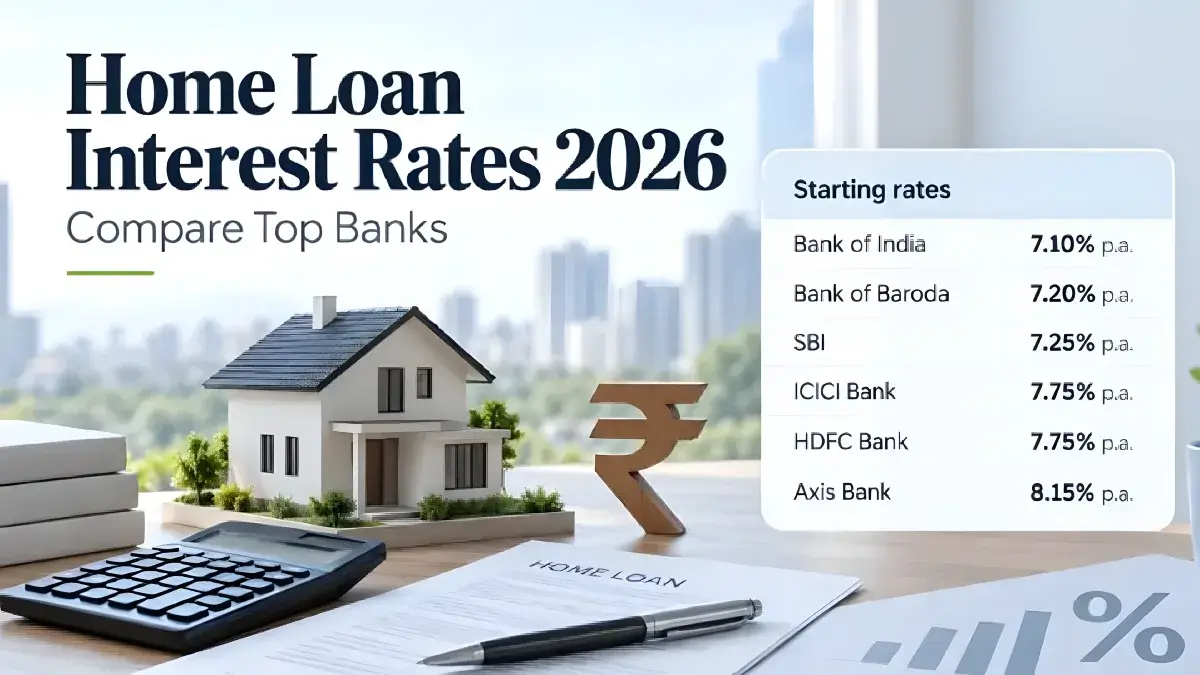
The table below compares Bank of India's home loan offering with other major lenders based on available data as of August–September 2026. Rates and fees can change and the final offer depends on the applicant's profile.
| Bank | Home Loan Rate | Processing Fee | Maximum Tenure |
|---|---|---|---|
| Bank of India | 7.10% onwards | 0.25%–0.50% | 30 years |
| SBI | 7.25% onwards | 0.35% (max ₹10,000) | 30 years |
| PNB | 7.25% onwards | Up to 0.35% | 30 years |
| HDFC Bank | 7.75% onwards | Up to 2% | 30 years |
| ICICI Bank | 7.50% onwards | Varies by profile | 30 years |
Bank of India's starting rate of 7.10% is competitive among public sector banks. The actual rate and total cost depend on your credit profile, the loan amount, and the applicable processing fee. Borrowers should compare the total cost — including processing fees and other charges — rather than focusing solely on the starting rate.
Factors That Can Affect Your BOI Home Loan Interest Rate
Several factors influence the final interest rate you receive from Bank of India:
CIBIL score: Higher scores typically qualify for a lower spread over the benchmark rate.
Borrower profile: Salaried vs. self-employed, income level, and employment stability.
Loan amount: Different pricing may apply to different loan size brackets.
Loan-to-Value ratio: The percentage of property value being financed.
Property characteristics: Location, age, and type of property.
Loan product: Different BOI home loan schemes may have different pricing structures.
Repayment capacity: Assessed based on income and existing liabilities.
Benchmark rate changes: Since BOI home loans are floating-rate products, changes in the RBLR affect your rate.
Improving any single factor does not guarantee a specific rate. The final rate is determined by Bank of India based on its internal pricing policies.
How RBI Rate Changes Can Affect Home Loan Rates
Bank of India's home loan rates are linked to the bank's Repo-Based Lending Rate (RBLR), which is influenced by the RBI's policy rate. When the RBI changes the repo rate, it can affect the cost of funds for banks, which in turn may influence benchmark lending rates.
However, an RBI rate change does not necessarily translate into an identical or immediate change in every home loan rate. Banks may adjust their spreads and pricing based on their own funding costs and business considerations. Borrowers should monitor their loan statements for any changes to their EMI or tenure.
BankerMart helps borrowers compare home-loan interest rates, EMI costs, eligibility requirements, fees and lender terms so they can evaluate available options. The platform provides information to support informed borrowing decisions without guaranteeing any particular rate, approval, or saving.
FAQs
What is the Bank of India Home Loan Interest Rate in October 2026?
Bank of India's home loan rate starts at 7.10% p.a. based on market data available as of August–September 2026. The actual rate depends on your CIBIL score, loan amount, and employment profile.
Is 7.10% the Bank of India home loan interest rate in October 2026?
7.10% p.a. is the starting rate available to eligible borrowers with strong credit profiles. The rate is not uniform for all applicants — your final rate may be higher depending on your CIBIL score and profile.
What is the EMI for a ₹50 lakh BOI home loan at 7.10%?
At 7.10% p.a. for 20 years, the approximate EMI is ₹39,085. For 30 years, it is approximately ₹33,623. Actual EMI depends on the final approved rate and tenure.
What is the EMI for a ₹1 crore BOI home loan at 7.10%?
At 7.10% p.a. for 20 years, the approximate EMI is ₹78,170. For 30 years, it is approximately ₹67,246.
What is the BOI home loan interest rate for a 20-year loan?
The rate depends on your CIBIL score. For scores of 760 and above, the rate is RBLR + 2.00%. For scores between 675 and 759, it is RBLR + 2.50%. The applicable rate for a 20-year loan is the same as for other tenures — tenure does not change the rate, but it affects the EMI.
What CIBIL score is required for a BOI home loan?
Bank of India's official rate card indicates that a CIBIL score of 760 and above qualifies for the best rate category. Scores between 675 and 759 qualify for a higher spread. Scores below 675 are generally only considered for review of existing accounts.
What is the Bank of India home loan processing fee?
The processing fee varies by scheme, typically in the range of 0.25% to 0.50% of the loan amount. Borrowers should confirm the exact fee applicable to their chosen scheme at the time of application.
What documents are required for a BOI home loan?
Key documents include identity proof (PAN, Aadhaar), address proof, salary slips and Form 16 (salaried), IT Returns and financial statements (self-employed), property documents, and photographs.
Can self-employed people apply for a BOI home loan?
Yes. Bank of India offers home loans to both salaried and self-employed individuals. Self-employed applicants typically need to provide IT Returns, financial statements, and business proof for the last 3 years.
What is the maximum BOI home loan tenure?
Bank of India offers home loan tenures up to 30 years, subject to the borrower's age at application and product terms.
Can I prepay my Bank of India home loan?
Yes. Bank of India does not levy prepayment charges on floating-rate home loans for individual borrowers. Fixed-rate loans may attract charges as per the loan agreement.
Does Bank of India home loan interest rate change?
Yes. BOI home loans are floating-rate products linked to the bank's RBLR. The rate can change when the benchmark rate changes, which may affect your EMI or tenure.