Table of Contents
- 1. What is the SBI Mortgage Loan Calculator?
- 2. How Does the SBI Mortgage Loan Calculator Work?
- 3. SBI Mortgage Loan EMI Table for 2026
- 4. SBI Loan Against Property Interest Rate 2026
- 5. SBI Mortgage Loan Eligibility
- 6. Documents Required for SBI Mortgage Loan
- 7. Loan Amount & LTV Ratio
- 8. SBI Mortgage Loan Processing Fee & Charges
- 9. Prepayment & Foreclosure Rules
- 10. SBI Mortgage Loan vs Home Loan
- 11. SBI Mortgage Loan vs Gold Loan
- 12. Real-Life Scenario: Calculating Your Loan
- 13. Tips to Lower Your SBI Mortgage Loan EMI
- Frequently Asked Questions (FAQs)
- Conclusion
Getting a loan against your property can be a smart way to raise funds for business growth, education, or any major expense. The SBI Mortgage Loan, also known as the SBI Loan Against Property (LAP), lets you unlock the value of your residential or commercial property. But before you apply, understanding your monthly financial commitment is crucial.
The SBI Mortgage Loan Calculator—also referred to as the SBI Loan Against Property EMI Calculator—is your first step. This free tool instantly calculates your monthly payment (EMI), total interest, and overall repayment based on your loan amount, interest rate, and tenure. This comprehensive guide explains how to use the calculator effectively, breaks down SBI's interest rates and charges for 2026, explains eligibility and documentation, and shows you how BankerMart can help you compare this offer with other lenders.
1. What is the SBI Mortgage Loan Calculator?
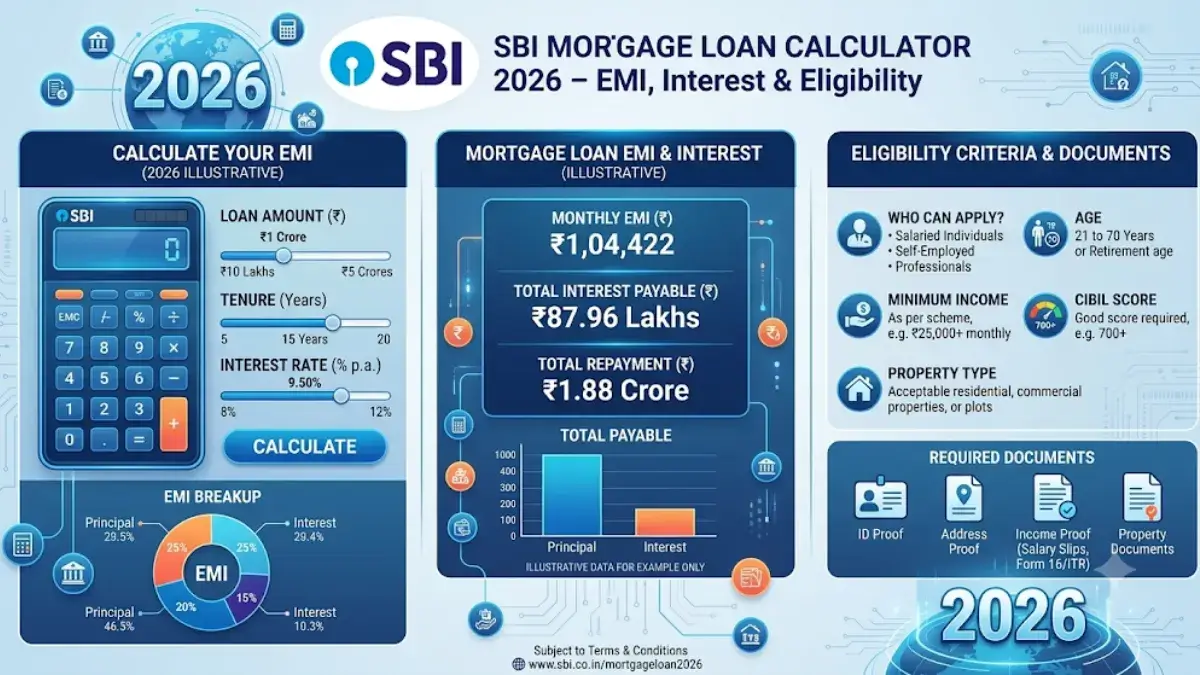
The SBI Mortgage Loan Calculator is an online tool that estimates the Equated Monthly Installment (EMI) for a Loan Against Property from the State Bank of India. To use the calculator, you only need three inputs:
Loan Amount: The amount you plan to borrow against your property.
Interest Rate: The annual rate offered by SBI for your specific LAP product.
Loan Tenure: The repayment period, usually up to 15 years for a mortgage loan.
The tool instantly provides a clear breakdown of your financial commitment, helping you plan your monthly budget and total interest cost before you finalize the loan .
2. How Does the SBI Mortgage Loan Calculator Work?
The SBI Mortgage Loan EMI Calculator uses a standard mathematical formula to compute your EMI. It ensures you know the exact figure you'll be paying each month.
The EMI Formula:
The formula used by all financial institutions in India is :
EMI = P × r × (1+r)ⁿ / [(1+r)ⁿ – 1]
Where:
P is the Principal loan amount.
r is the monthly interest rate, calculated as
(Annual Rate / 12) / 100.n is the loan tenure in months (e.g., 15 years × 12 = 180 months).
Example Calculation:
For a ₹50 Lakh loan at 8.50% annual interest for 15 years:
P = ₹50,00,000
r = 8.50 / 12 / 100 = 0.00708
n = 15 × 12 = 180 months
EMI = approximately ₹49,248 per month
This means you would pay about ₹49,248 every month for 15 years to repay this loan.
3. SBI Mortgage Loan EMI Table for 2026
Home Loan EMI Calculator
Live| 📊 Rate | 8.50% |
| ⏱️ Tenure | 20 years |
| 💰 Total Interest | ₹ 0 |
| 💵 Total Payment | ₹ 0 |
Amortization Schedule Monthly
| # | Date | EMI (₹) | Principal (₹) | Interest (₹) | Balance (₹) |
|---|---|---|---|---|---|
| Calculating... | |||||
The table below shows estimated EMIs for different loan amounts and tenures based on an 8.50% interest rate. Actual rates may vary based on your credit score and risk profile .
Based on an Indicative Rate of 8.50% p.a.
| Loan Amount | 5 Years | 10 Years | 15 Years | 20 Years | 25 Years |
|---|---|---|---|---|---|
| ₹10 Lakh | ₹20,517 | ₹12,399 | ₹9,847 | ₹8,678 | ₹8,052 |
| ₹20 Lakh | ₹41,035 | ₹24,799 | ₹19,694 | ₹17,356 | ₹16,104 |
| ₹30 Lakh | ₹61,552 | ₹37,198 | ₹29,541 | ₹26,035 | ₹24,156 |
| ₹50 Lakh | ₹1,02,587 | ₹61,997 | ₹49,248 | ₹43,391 | ₹40,260 |
| ₹75 Lakh | ₹1,53,880 | ₹92,995 | ₹73,872 | ₹65,086 | ₹60,390 |
| ₹1 Crore | ₹2,05,173 | ₹1,23,994 | ₹98,496 | ₹86,781 | ₹80,520 |
These figures are for reference only. Please use the BankerMart EMI Calculator for real-time estimates based on SBI's current rates.
Understanding the Table:
Choosing a longer tenure reduces your monthly EMI but increases the total interest you pay over the entire loan term. For example, a ₹1 crore loan at 8.50% has a monthly EMI of around ₹2.05 lakh for 5 years, but this drops to nearly ₹98,500 for 15 years.
4. SBI Loan Against Property Interest Rate 2026
SBI's interest rates for Loan Against Property are typically higher than standard home loans due to the different purpose and risk assessment.
Current SBI LAP Interest Rates (Indicative)
The interest rate varies based on your credit score, loan amount, and repayment history. Generally, rates start from around 9.20% to 10.75% per annum for higher credit scores.
Here’s how SBI LAP interest rates typically range:
| Credit Profile | Rate of Interest (p.a.) |
|---|---|
| Excellent CIBIL Score (750+) | Starting from 9.20% - 9.50% |
| Good CIBIL Score (700 - 750) | 9.50% - 10.00% |
| Average or New to Credit | 10.00% - 10.75% |
| Other Loan Against Property Products | Up to 11.30% |
Important Note:
SBI's LAP is linked to an external benchmark like the Repo Rate, so rates can change.
A CIBIL score of 750 or above is recommended to secure the lowest available rate.
SBI LAP vs. Competitors
SBI's rates are competitive. However, private banks like ICICI or HDFC might offer different rates. On BankerMart, you can compare SBI’s LAP interest rate with other leading banks instantly and side-by-side.
5. SBI Mortgage Loan Eligibility
Your eligibility for an SBI Loan Against Property is based on your financial profile and the value of the property.
Key Eligibility Criteria:
Factors Affecting Eligibility:
Income Stability: A stable job or business history (3+ years) strengthens your application .
Property Value: The loan amount is based on a percentage (LTV) of the property's market value.
Existing Liabilities: Your existing loan EMIs are considered to calculate your repayment capacity.
6. Documents Required for SBI Mortgage Loan
A smooth application requires a complete set of documents. The list is categorized into identity, income, and property papers.
Document Checklist:
7. Loan Amount & LTV Ratio
The Loan-to-Value (LTV) ratio defines the maximum amount SBI can sanction against your property.
LTV Ratio for SBI Loan Against Property
| Loan Amount | Maximum LTV |
|---|---|
| Up to ₹30 Lakh | Up to 90% |
| ₹30 Lakh to ₹75 Lakh | Up to 80% |
| Above ₹75 Lakh | Up to 75% |
For instance, if your property is valued at ₹1 Crore, the maximum loan you can get is generally ₹75 Lakhs (75% of the value). A higher LTV may be considered for smaller loans (up to ₹30 Lakhs).
8. SBI Mortgage Loan Processing Fee & Charges
SBI charges a processing fee for LAP, which is a one-time cost.
Fee Structure
| Charge Type | Details |
|---|---|
| Processing Fee | 1% of the loan amount plus applicable taxes. |
| Maximum Fee | Capped at ₹50,000 (provides certainty for large loans). |
| Legal & Technical Fee | Actual charges for property valuation and title verification. |
| CERSAI Registration | ₹50 - ₹100 for registering the mortgage. |
| Foreclosure/Prepayment | Nil for individual borrowers on floating-rate loans. |
Important Tip:
Before applying, use the BankerMart Mortgage Loan Comparison tool to see how SBI’s processing fees and interest rates stack up against other banks. A difference of just 0.25% in the rate can save you thousands in the long run.
9. Prepayment & Foreclosure Rules
Floating Rate Loans: SBI levies no charges on prepayment or foreclosure for individuals (under RBI guidelines). This gives you flexibility to close the loan early without penalty.
Fixed Rate Loans: Prepayment charges may apply (typically around 2%).
10. SBI Mortgage Loan vs Home Loan
Many people confuse a Mortgage Loan (Loan Against Property) with a Home Loan, but they serve different purposes.
| Feature | Home Loan | Mortgage Loan (LAP) |
|---|---|---|
| Purpose | To buy, construct, or renovate a house. | To raise funds for business, education, or other needs. |
| Interest Rate | Lower (e.g., starting from 8.50%). | Higher (e.g., starting from 9.20%). |
| Maximum Tenure | Up to 30 years. | Up to 15 years. |
| Tax Benefits | Tax benefits on principal and interest (under Sec 80C, 24b). | Generally, no tax benefits unless used for the property itself. |
| End Use | Specific to the property being financed. | Flexible for any end-use. |
You should choose a Home Loan if buying a house, and a Mortgage Loan if your property is already owned and you need funds for another purpose.
11. SBI Mortgage Loan vs Gold Loan
If you are considering a secured loan against an asset, you might also consider a Gold Loan.
| Feature | Mortgage Loan (LAP) | Gold Loan |
|---|---|---|
| Asset Pledged | Immovable property (House, Commercial, Land). | Physical gold ornaments or coins. |
| LTV | Up to 90% (lower for higher amounts). | Up to 90% of the gold value. |
| Tenure | Up to 15 years. | Up to 3 years. |
| Interest Rate | Starting from ~9.20%. | Lower (starting from ~6-9%). |
| Processing | Lengthy, involves legal & technical verification. | Much faster and less documentation. |
| Loan Amount | Large amounts (up to ₹7.5 Crores or more). | Limited to the value of gold pledged. |
Bottom Line: Choose a Gold Loan for short-term, quick, small amount needs. Choose a Mortgage Loan for long-term, large amount needs (₹10 Lakhs and above).
12. Real-Life Scenario: Calculating Your Loan
Let's consider a small business owner, Mr. Sharma, who wants to expand his business. He owns a residential property worth ₹1.5 Crores.
His Requirement:
Loan Amount Needed: ₹75 Lakhs.
Property Value: ₹1.5 Crores (LTV for this amount is ~80-75%, so ₹75 Lakhs is eligible).
Using the BankerMart EMI Calculator:
He inputs:
Loan Amount: ₹75,00,000
Interest Rate: 9.5% (after a good CIBIL score)
Tenure: 15 Years
Result:
EMI: ~₹78,382 per month.
Total Interest Paid: ~₹66.08 Lakhs
Total Payment: ~₹1.41 Crores.
This clear calculation allows Mr. Sharma to plan his business cash flow effectively.
13. Tips to Lower Your SBI Mortgage Loan EMI
Getting the lowest EMI is about more than just accepting the first offer.
Boost Your CIBIL Score: A score of 750+ significantly lowers your interest rate.
Increase Down Payment: A larger down payment reduces the principal and the overall interest.
Opt for a Longer Tenure: While it increases total interest, it reduces the monthly EMI burden.
Consider a Joint Applicant: Adding a family member with a good income and credit score can lower the risk and help secure a better rate.
Compare on BankerMart: Do not settle for one quote. Compare SBI's LAP offering with ICICI, HDFC, PNB, and others to find the lowest available rate.
Frequently Asked Questions (FAQs)
1. What is an SBI Mortgage Loan?
An SBI Mortgage Loan (Loan Against Property) is a secured loan where you mortgage your residential or commercial property to SBI in exchange for funds for business, education, or other needs.
2. What is an SBI Mortgage Loan EMI Calculator?
It is a free online tool that calculates your monthly EMI for a Loan Against Property. Enter the loan amount, interest rate, and tenure to see your EMI instantly.
3. What is the interest rate for SBI Loan Against Property in 2026?
The SBI LAP interest rate in 2026 typically starts from 9.20% per annum and can go up to 10.75% or higher, depending on your credit score and profile .
4. What is the maximum tenure for an SBI Mortgage Loan?
SBI offers a maximum repayment tenure of 15 years for loans against property .
5. What is the LTV ratio for SBI LAP?
The maximum LTV is up to 90% for loans up to ₹30 Lakh, 80% for ₹30-75 Lakh, and 75% for loans above ₹75 Lakh.
6. What is the processing fee for SBI Loan Against Property?
The processing fee is generally 1% of the loan amount, capped at a maximum of ₹50,000 plus applicable taxes .
7. Does SBI charge a prepayment penalty on LAP?
No. SBI does not charge any prepayment or foreclosure penalty on floating-rate mortgage loans for individual borrowers .
8. What documents are required for an SBI Mortgage Loan?
You need KYC documents, income proof (salary slips/ITR), bank statements, and comprehensive property documents including the sale deed and tax receipts .
9. Can I get an SBI Mortgage Loan for commercial property?
Yes, SBI accepts both residential and select commercial properties for Loan Against Property applications .
10. How to use the SBI Mortgage Loan Calculator on BankerMart?
Visit the BankerMart website, open the EMI calculator, select \"SBI\" and \"Loan Against Property\", enter your desired loan amount, tenure, and an estimated interest rate to view your EMI instantly.
11. Are there tax benefits on SBI Loan Against Property?
Generally, tax benefits are not available on a Loan Against Property if the funds are used for non-property-related purposes.
12. What is the EMI for ₹50 Lakh SBI Mortgage Loan?
The EMI for ₹50 Lakh at 9.50% for 15 years is approximately ₹52,224. Your exact EMI will depend on the final rate you are offered.
13. Can a self-employed person get an SBI Mortgage Loan?
Yes. SBI provides LAP to self-employed individuals and business owners based on their Income Tax Returns (ITR) and business continuity.
14. What is the minimum CIBIL score required for SBI LAP?
A CIBIL score of 750 and above is required to secure the best and lowest interest rates on your SBI LAP .
15. How can I compare SBI Mortgage Loan with other banks?
Use BankerMart’s free comparison tool. It allows you to evaluate the interest rates, EMIs, and charges of SBI alongside multiple lenders in real-time to find the best deal.
Conclusion
The SBI Mortgage Loan Calculator is an essential tool for anyone planning to take a Loan Against Property. It gives you a clear picture of your financial commitment and helps you choose a loan structure that aligns with your budget and goals. SBI offers competitive interest rates, a transparent fee structure, and the huge benefit of zero prepayment penalties on floating-rate loans .